

Blog Resources
Browse our full library of articles, whitepapers, and case studies.
35 resources

Data Integrity in Pharma: ALCOA+, Regulators, and the 483 Failures
Data integrity in pharma: the nine ALCOA+ principles with examples, FDA/MHRA/WHO expectations, the recurring 483 failures, and revised Schedule M.

21 CFR Part 11: What It Is and What It Requires
What 21 CFR Part 11 requires in plain English: electronic records and signatures, predicate rules, audit trails, validation, and Annex 11 mapping.

Swab Sampling Procedure for Cleaning Validation: Methods, Recovery and Limits
How to run swab and rinse sampling for cleaning validation — worst-case locations, the swab technique, recovery studies, the swab limit, and visual checks.

MACO Calculation: Methodology and Formulas for Cleaning Validation
How to calculate MACO three ways — health-based (PDE/ADE), dose-based, and 10 ppm — with formulas, a worked example, and an interactive calculator.

Cleaning Validation Guidelines: A Regulator-by-Regulator Guide
Cleaning validation guidelines mapped regulator by regulator — what FDA, EU GMP Annex 15, EMA, PIC/S, ICH, WHO and APIC require, and where they differ.

Cleaning Validation Protocol: A Step-by-Step Guide
How to design, execute and defend a cleaning validation protocol — worst-case selection, HBEL/MACO limits, sampling, hold times and audit-ready records.

What Does It Mean to Review an AI-Generated Document?
FDA's first AI warning letter went to a company with no quality unit. Your company has one. Your QA team is signing AI outputs they cannot explain. That is the same structural failure — with better credentials attached.

Do Five AI Systems Add Up to One Quality System?
Pharmaceutical manufacturers are deploying AI point by point — LIMS, MES, DMS, deviation, CAPA — each system confident within its domain, none connected across them. Cross-system quality events are the highest-risk events in manufacturing. They are also the events that each point AI is structurally least equipped to handle.

Should We Be Validating AI, or Managing It?
GAMP 5 was designed for deterministic software. AI is probabilistic — it fails on inputs outside its training distribution, which are by definition the cases your test library couldn't cover. The right governance model for AI isn't a qualification document. It's the framework you already use for new hires.
FDA's First AI Warning Letter Is Not About AI
FDA issued its first AI-specific warning letter to a manufacturer that used AI to generate SOPs and production records without qualified human review. The industry's response will be 'add a sign-off.' That response misses what the letter actually established.

The Document Was Approved. Nobody Told the Floor.
The gap between a document reaching effectivity and operators being formally qualified to it is a direct product of DMS architecture — not operator negligence. The DMS handed off. The LMS was waiting. No system was watching the window in between.

The Periodic Review That Isn't: Why Calendar-Based SOP Cycles Create Compliance Records Without Creating Compliant Documents
Most pharmaceutical DMS platforms schedule SOP reviews by elapsed time, not by risk. The result is a completion record confirming the review happened — and no mechanism to confirm the procedure is still current.

The Harmonisation Myth: Why Multi-Site DMS Deployments Mean One Contract and Fourteen Isolated Quality Systems
Your DMS contract covers every facility you operate. Your DMS architecture does not — and FDA's cross-facility enforcement does not observe that distinction.

The Checklist Illusion: Why Most 'AI' in Pharma Deviation Investigation Is Just Automation With Better Marketing
Most 'AI' deviation management systems are rule-based automation with better branding. Here's the architectural test that separates genuine contextual reasoning from a relabelled checklist.

The 90-Day SOP Trap: How Document Approval Cycles Became Your Biggest Compliance Liability
FDA's top 483 citation is 'procedures not followed' — but often the procedure existed. It was stuck in approval. Here's why legacy DMS vendors profit from that delay.

Change Control Blindness: Your DMS Can't Tell You Which Documents Need Updating After This Week's FDA Guidance
When FDA publishes new guidance, legacy DMS platforms have no way to automatically identify affected SOPs. Here's the architectural gap — and why it keeps generating 483 observations.

The Pre-Inspection Scramble: Why Pharma Companies Spend Weeks on Document Packages AI Could Generate in Hours
FDA inspection preparation consumes weeks of quality team capacity not because it's complex — but because legacy DMS cannot answer cross-system regulatory questions.

The Human Bottleneck Paradox: How LMS Systems Waste QA Time on AI Work
QA directors spend 80% of their time on administrative training tasks while rushing through critical regulatory approvals—and traditional LMS vendors profit from this inversion.

Why FDA's AI Gives Them an Unfair Advantage Over Your Document Management Strategy
FDA deploys ELSA AI to analyze submissions while pharma uses keyword search for SOPs. The regulatory intelligence gap is widening—and it's becoming a compliance liability.

Beyond Point Solutions: Building Reusable Integration Architecture for Manufacturing Digital Transformation
Most manufacturing companies burn millions on custom integrations that break, don't scale, and create vendor lock-in. Here's the platform approach that's changing enterprise architecture — starting with a chemical manufacturer's SAGE ERP and Dataparc historian integration.

The Validation Debt Crisis: Why Your Multi-Site Strategy Is Creating Competitive Disadvantage
Organizations clinging to single-site validation methodologies across multiple facilities are accumulating massive validation debt that will cripple their ability to scale and adapt. Here's the structured framework that separates industry leaders from laggards.

Campaign Length Studies: The Cleaning Validation Liability Every Quality Leader Is Ignoring
While quality teams focus on routine cleaning validation, systematic gaps in campaign length methodology are creating competitive disadvantage and bleeding millions in unnecessary costs across pharmaceutical manufacturing.

The Hidden P&L of Quality: Why Your Cost-of-Quality Number Is Wrong
Most pharma companies report cost of quality at 15-20% of revenue. The real number is 25-40% once you count investigation labor, batch hold costs, and regulatory remediation.

The Multi-Site Quality Trap: Same Company, Different Standards, One FDA Inspector
A company with 30 sites doesn't have one quality system — it has 30 quality systems wearing the same logo. When FDA inspects Site B, they compare it to what they saw at Site A. Here's why every harmonisation initiative fails, and what the missing layer actually is.

Why Your Best Quality Leaders Spend 70% of Their Time on Documentation, Not Quality
The people who understand your process best are drowning in paperwork — writing investigation reports, reviewing batch records, compiling APRs. This is the talent crisis no one talks about.

Why Your Deviation Investigation Takes 45 Days (and How Agentic AI Cuts It to 5)
Deviation investigations stall at root cause analysis because data lives in silos. How AI agents correlate batch, environmental, and equipment data to compress 45-day cycles to 5.

Your QMS Is a Melting Ice Cube
Traditional quality management systems like Veeva, TrackWise, and MasterControl are structurally obsolete. Here's why agentic AI will replace them within two years — and what pharma leaders should do now.

The Last Generation of Per-Seat Pharma Software
Per-seat licensing made sense when humans did the work. When AI agents do the work, the pricing model — and the vendors built on it — collapse. Here's the math.

Your Next QA Hire Should Be an AI Agent
A practical guide for pharma quality leaders on deploying AI agents in quality operations — the economics, the regulatory framework, and a 90-day pilot that proves the case.
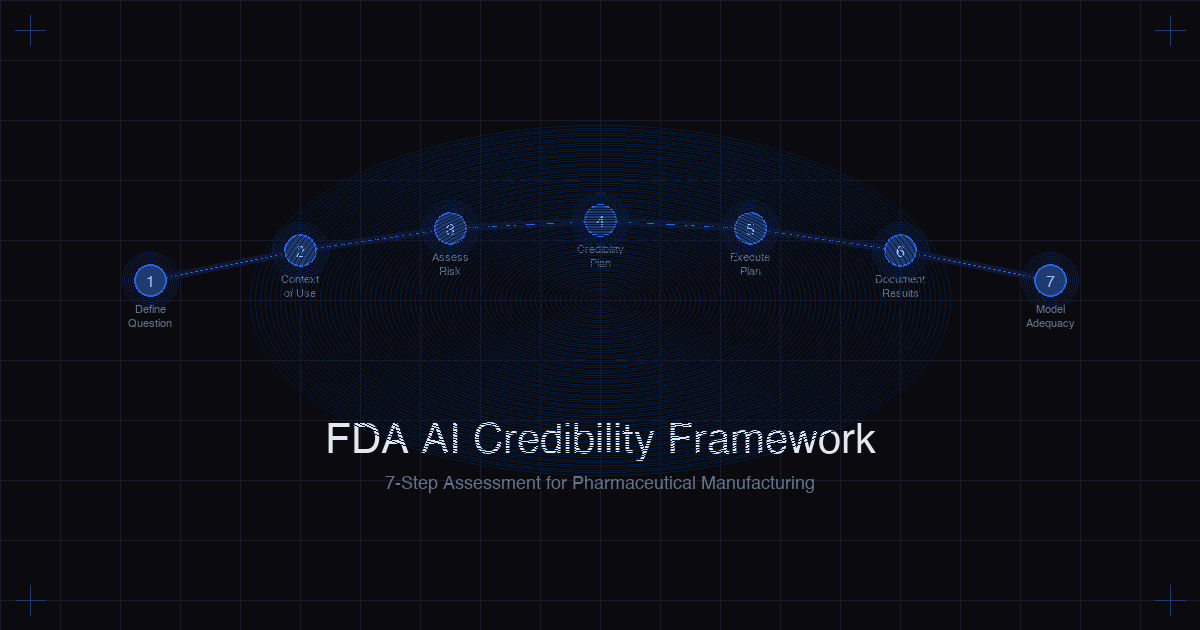
FDA's AI Credibility Framework: What It Means for Pharma Manufacturing
How FDA's 7-step AI credibility assessment framework applies to pharmaceutical manufacturing — and why architecture determines whether your AI systems pass regulatory scrutiny.

Intelligence Units: A Framework for Measuring Agentic AI
Tokens measure cost. Intelligence Units measure capability. A framework for decomposing what AI agents actually do — reasoning, tool calls, data retrieval, and model selection.

Why Now? AI in Pharmaceutical Manufacturing
Five converging forces — regulatory, technological, economic, workforce, and competitive — are creating an irreversible tipping point for AI adoption in pharma manufacturing.

Agent Skills vs. Prompts: The Architecture That Makes AI Work
Skills — not prompts — are what separate AI demos from production agents. How skills, sub-agents, and delegation enable goal-directed AI in pharma manufacturing.

Electronic Batch Records (eBR): What They Are and How They Work
An electronic batch record (eBR) replaces the paper batch record with a guided, signed, audit-trailed digital record built as the batch runs.

How AI Is Transforming Pharmaceutical Quality Management
Explore how artificial intelligence is reshaping quality management systems in pharma manufacturing, from deviation detection to predictive analytics.