

FDA-compliant shop floor, with AI-powered Leucine MES.
The AI-native manufacturing execution system that guides every batch as it runs and acts on the data instead of just recording it. One 21 CFR Part 11 platform from the shop floor to QA release.






The problem
Every paper batch record is a 483 waiting to happen.
Errors captured by hand, found at review. The most expensive place to find them.
Deviations go uncaught
A skipped step or missed check passes in the moment, then surfaces days later at review.
Data integrity erodes
Data integrity citations appear in over 60% of FDA warning letters to pharma manufacturers: the single most consistent inspection finding.
You pay at release
Hidden until review, batches stall for weeks and every deviation widens FDA audit scope.
The product
Fully connected, from plan to release.
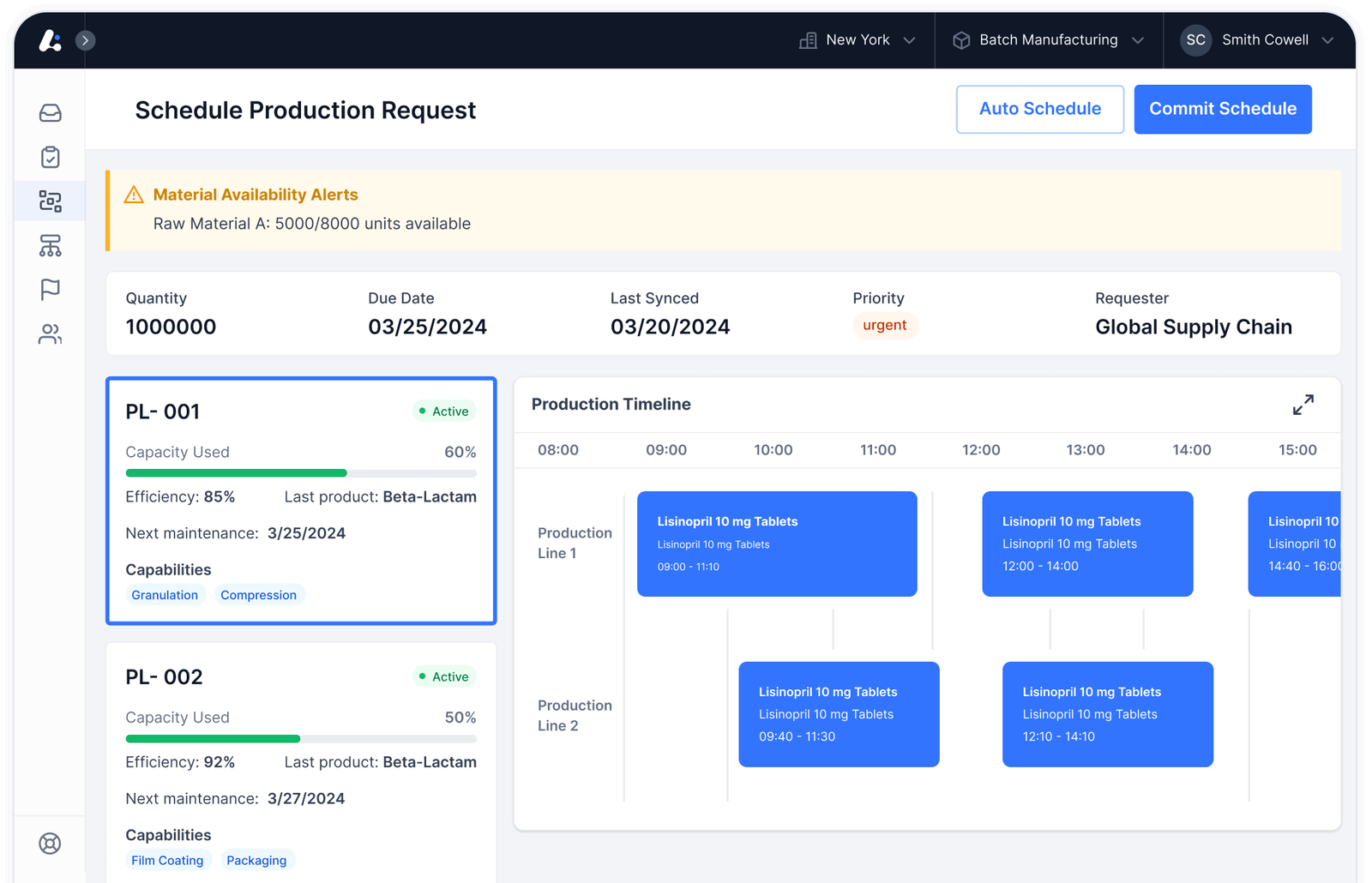
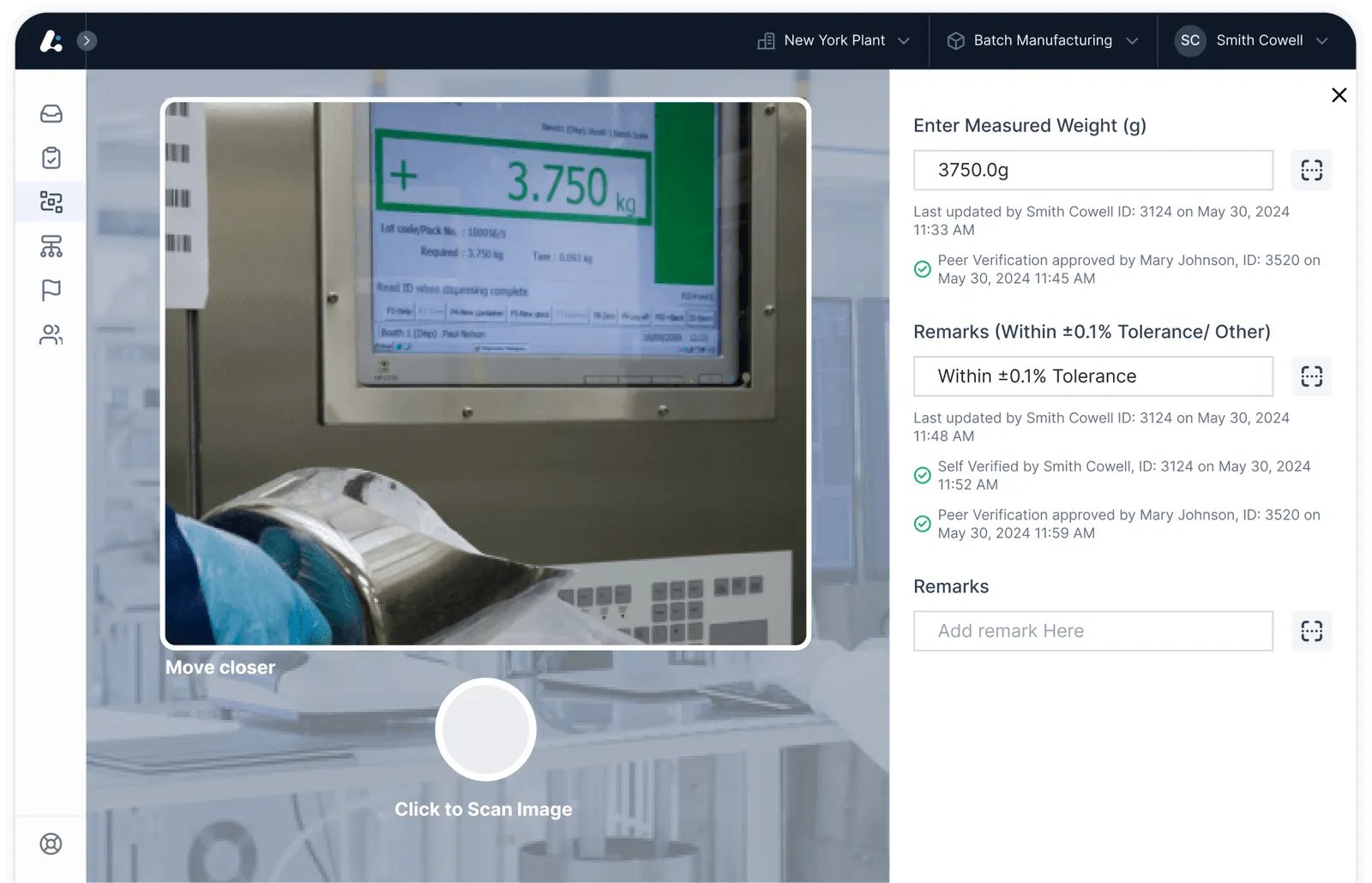
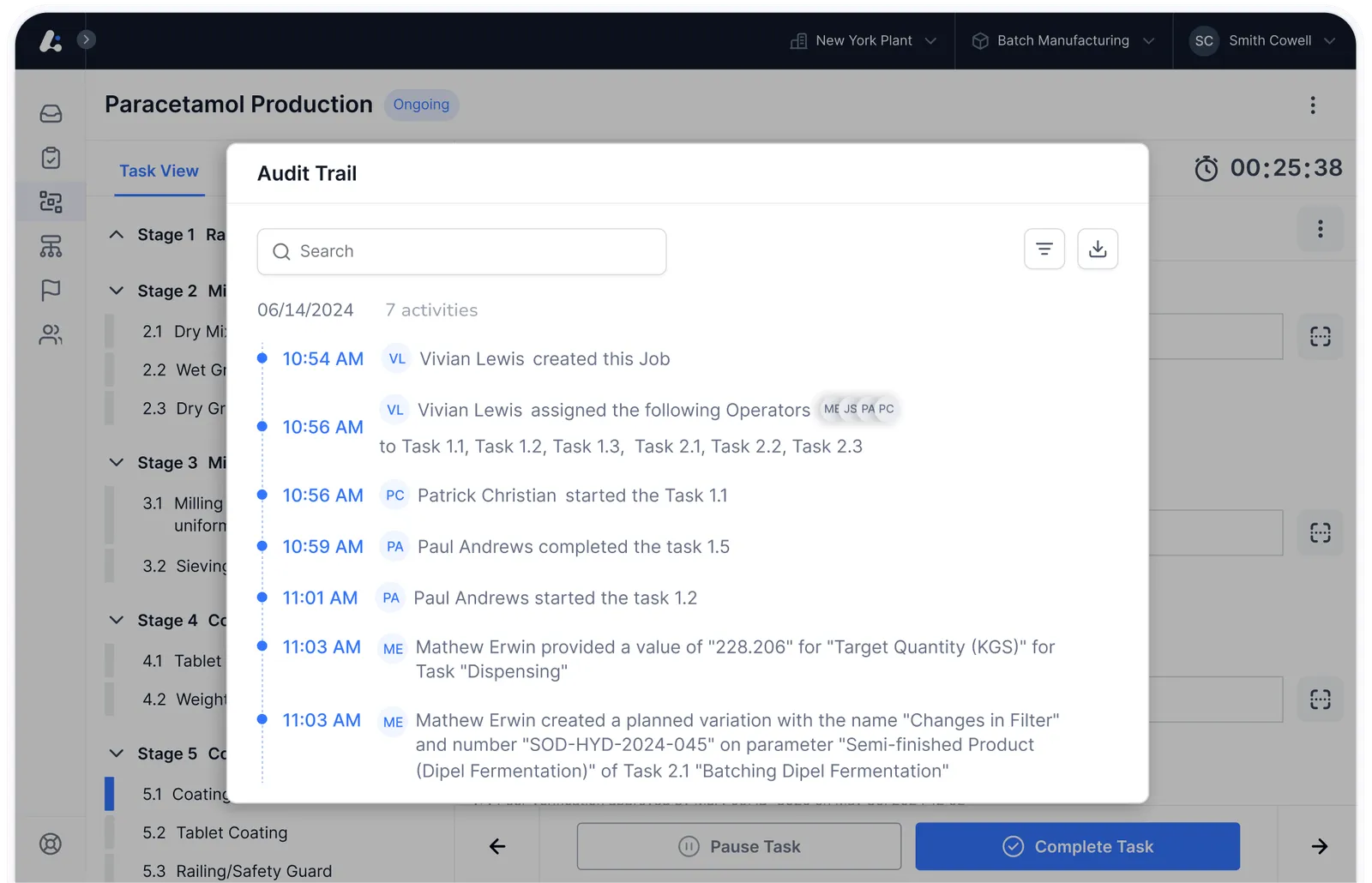
Follow a batch across Leucine MES: scheduled, executed, dispensed, logged, recorded, and analysed. Not six tools bolted together; one system, one record.
Integrations
Every integration pre-built. No middleware, no project.
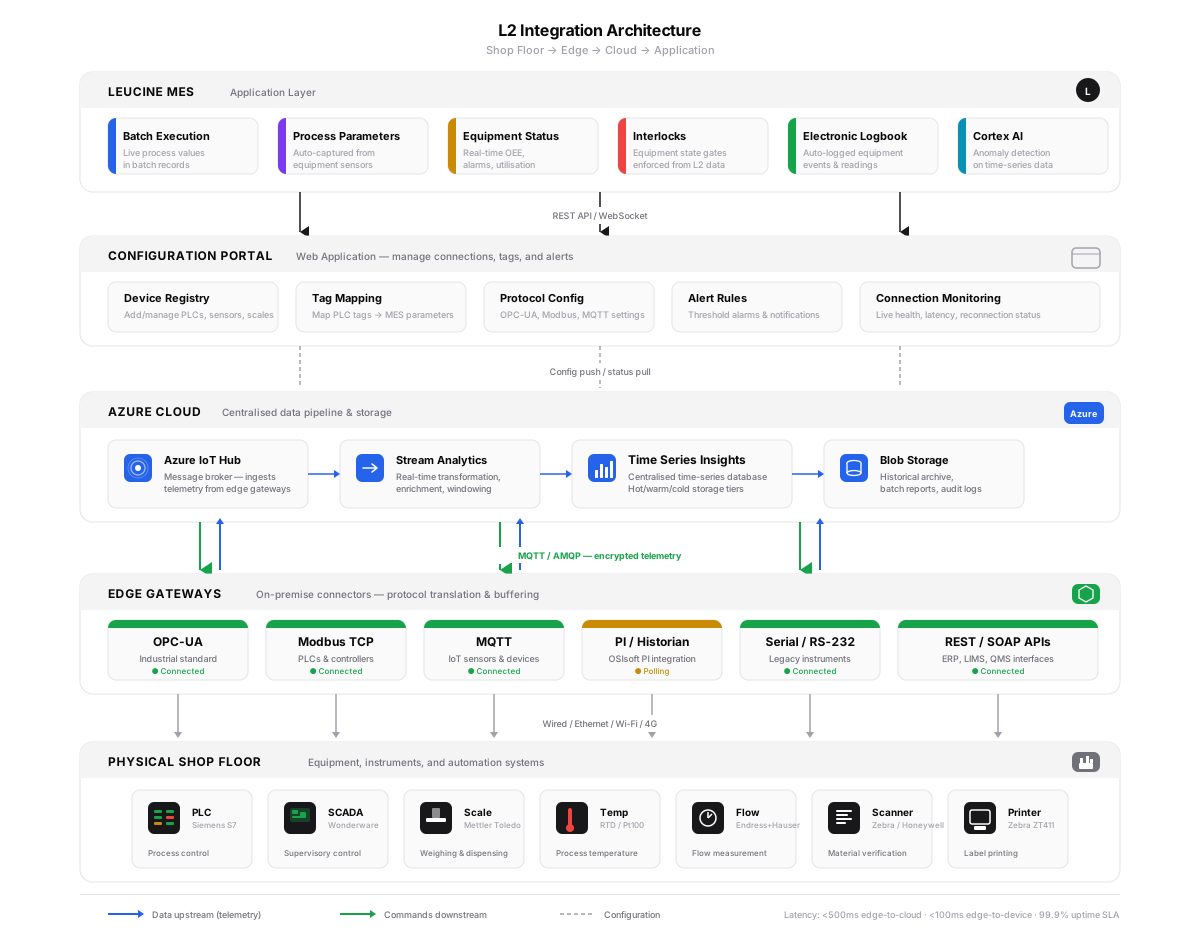
Connect to your existing automation layer (PLCs, SCADA, historians, balances) through pre-built edge connectors and an Azure pipeline. No custom middleware, no integration project.
Edge Gateway Connectors
OPC-UA, Modbus TCP, MQTT, PI/Historian, Serial RS-232, and REST/SOAP connectors translate data at the edge. Brownfield PLCs and SCADA connect without modification.
Azure Cloud Pipeline
Ingestion via Azure IoT Hub, Stream Analytics and Time Series Insights, enriched with batch context before it enters the MES data layer.
Configuration Portal
Manage device registries, tag mappings, protocol configs and alert rules from the browser. No engineering involvement required.
Real-Time Equipment Data
Live process values flow straight into batch records and interlocks; set-point deviations trigger in-line alerts automatically.
Protocols & platforms
Cortex
Your MES records the batch. Cortex acts on it.
Cortex agents reason over every batch in real time, detecting deviations, predicting yield, and resequencing schedules, while every recommendation flows through your existing approval workflows with a full 21 CFR Part 11 audit trail.
Compliance Agent
Monitors batch execution against GMP in real time, flags deviations before they escalate, surfaces review-by-exception candidates, and pre-populates investigation reports.
1 of 24 steps needs QA: humidity breached the 45% RH ceiling during drying. Draft investigation ready.
Yield Optimization Agent
Analyses parameters across thousands of historical batches to find what drives the best outcomes, recommends real-time adjustments, and predicts yield before completion.
Hold drying to 38 minutes: projected +0.9% yield on this batch.
Efficiency Agent
Optimises batch scheduling, predicts equipment bottlenecks, and reduces cycle times, forecasting throughput impact of changeovers and planned maintenance.
Resequence the Suite B-12 changeover: saves 6.2 hrs this week.
Example recommendations. In a walkthrough, Cortex runs on your products, processes, and parameters.
Proven at Scale
Running in production at 400+ GMP facilities
New Jersey, USA
Automated HBEL-based cleaning validation with risk-based protocol generation, ensuring continuous FDA and EMA compliance.









Impact studies
From paper to proven. Named customers, measured outcomes.
From the world's largest biorational plant to India's largest manufacturing network: what changed when paper batch records became a single, AI-native 21 CFR Part 11 system.
Down from 20, with 2,700 hours saved annually and 60% fewer manual data entries.
Read the impact study CiplaAcross 30 sites and 8,000+ credentialed staff. World's largest paperless manufacturing deployment.
Read the impact study Piramal PharmaFDA, MHRA and EMA on one standard. 100% 21 CFR Part 11 from day one.
Read the impact study Instapill200M unit capacity built paperless, across 3 production blocks and 6 export markets.
Read the impact studyUse cases
How pharma teams use Leucine MES on the shop floor.
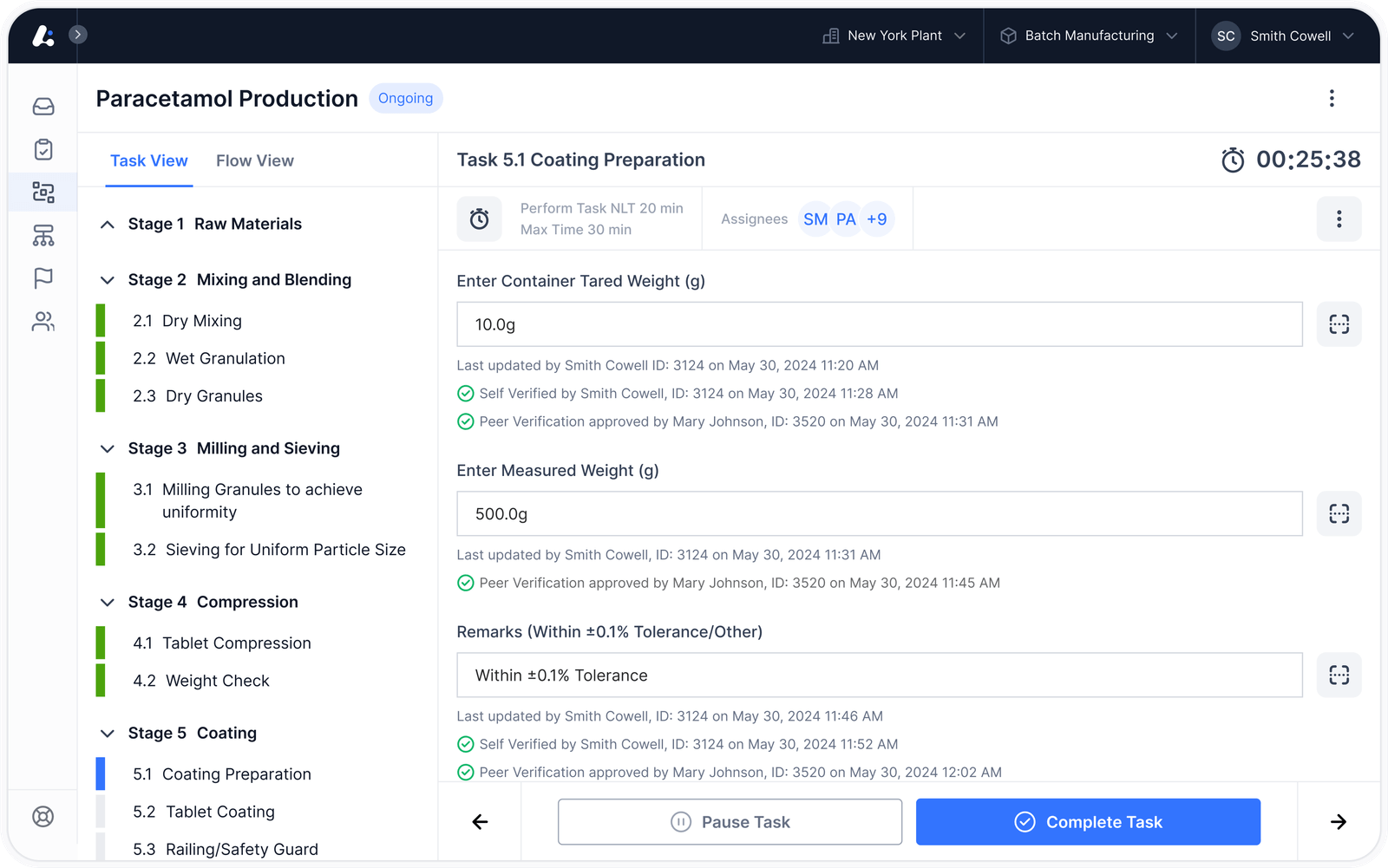
Paperless Batch Execution
Read the use case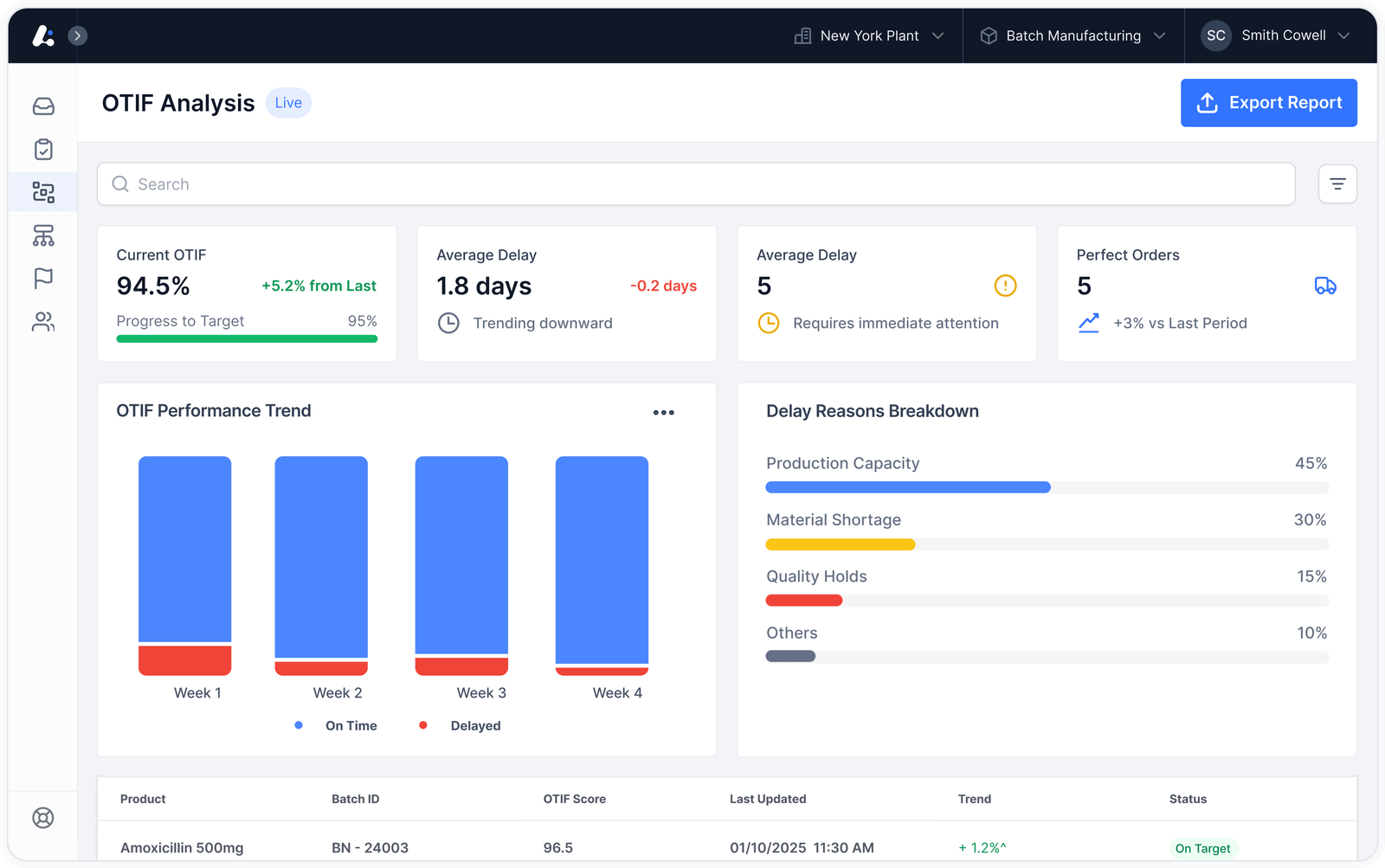
AI-Powered Batch Review & Release
Read the use case Cross-Site Production Visibility & Scheduling
Read the use case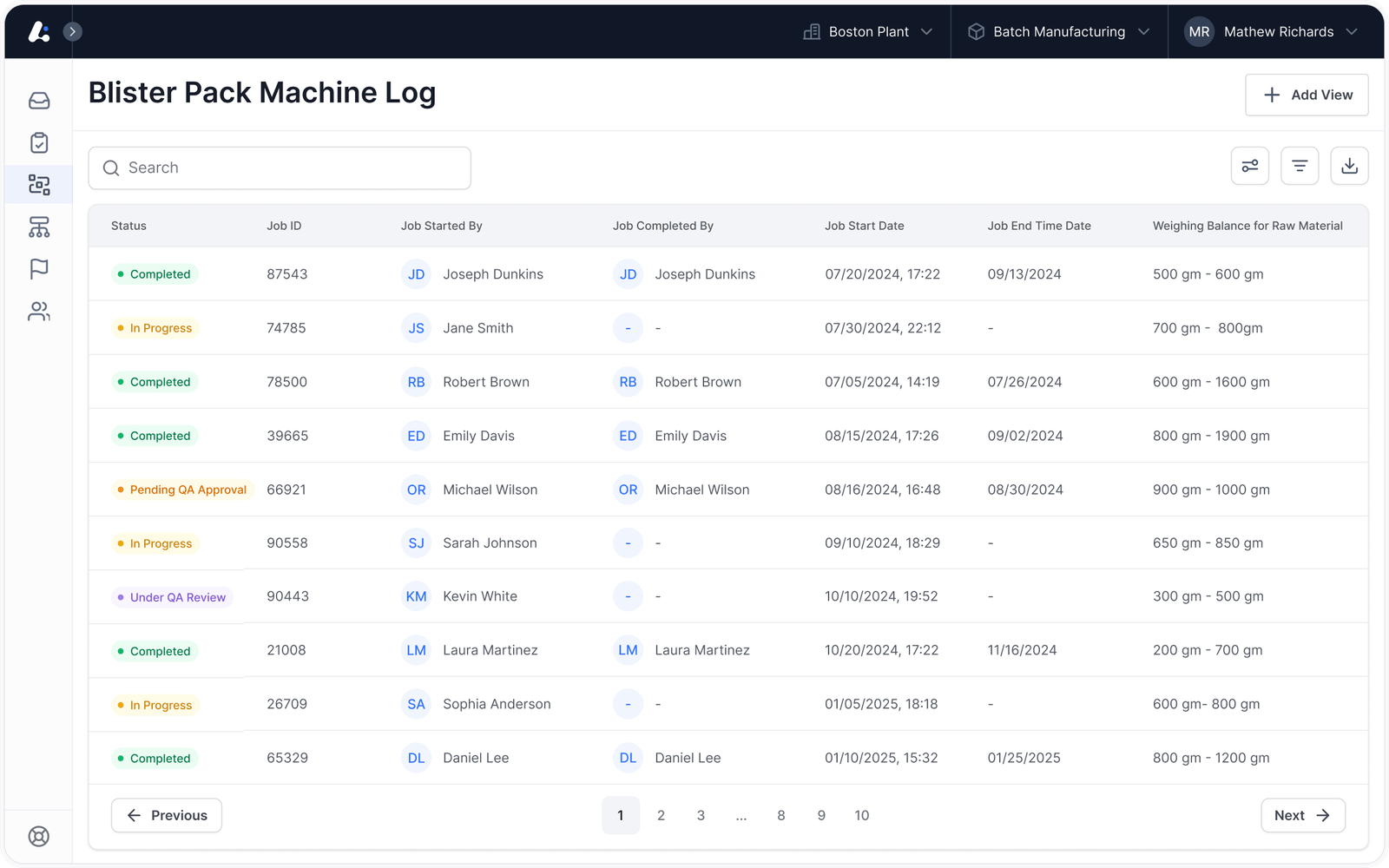
Electronic Logbooks & Area Management
Read the use caseImplementation
Start with EBR, grow into a full MES
A phased rollout that earns compliance value from week one. Most sites go live in 8–12 weeks through configuration, not custom development, then expand into batch records, Cortex, and equipment integration on your timeline.
Start where compliance risk is highest. Digitise the logbooks that run the floor every shift, so handovers are structured and every entry is inspection-ready, before a single batch record is touched.
- Area clearance, equipment, cleaning & room logbooks
- Structured electronic shift handovers
- Searchable, 21 CFR Part 11 records from day one
Pricing
One subscription, priced by product.
Licensed by the products you actively manufacture (a master recipe, run at least once a year). Pricing scales as you roll out, and we scope a quote to your footprint on a call.
No per-seat fee.
Every subscription includes
Enterprise infrastructure
Validated production and quality environments, unlimited-retention storage, managed backup, and disaster recovery.
Security and compliance
SOC 2 controls, IP and domain whitelisting, and annual vulnerability and penetration testing.
Onboarding and validation
A pre-executed GAMP 5 CSV package, master batch record configuration, project management, and training.
Support
A dedicated Key Account Manager, unlimited SLA-backed tickets, and monthly audit-readiness sessions.
Add as you scale: ERP, historian, LIMS, QMS, DMS, and weighing-balance integrations (SSO included), plus IP65 tablets and label printers.
FAQ
FAQs
AI & Cortex
How is an AI-native MES different from a traditional MES?
A traditional MES is a system of record: it digitises paper, enforces the workflow, and tells you what happened. An AI-native MES reasons over that same data and acts on it: Cortex agents detect deviations as they occur, predict yield, and resequence schedules, so reviewers work by exception instead of checking every line. Record-keeping is identical and just as compliant; the difference is that the system works the data for you, with every agent action running through your approval workflows and a full 21 CFR Part 11 audit trail.
Can Cortex act without human sign-off?
No. Cortex agents advise; humans decide. Every recommendation, whether a flagged deviation, a yield adjustment, or a schedule change, flows through your existing approval workflows, and nothing is committed without an authorised electronic signature. Every agent action traces back to the source record with a full 21 CFR Part 11 audit trail.
How are Cortex agents validated under GAMP 5 and 21 CFR Part 11?
Cortex runs inside the same validated, controlled environment as the rest of the platform. Models are qualified against defined acceptance criteria before release, their performance is monitored continuously in production, and any model update runs through formal change control with regression evidence, so your validated state is never silently altered. Agents also never write to the record on their own: every recommendation is an input to your existing approval workflow, committed only on an authorised electronic signature and traced end to end in the 21 CFR Part 11 audit trail. You validate the controls around the agents and the human decision points, not a black box.
Deployment & migration
How long does it take to deploy Leucine MES at a new site?
Most sites go live in 8–12 weeks. Leucine MES ships with pre-configured templates for common pharma workflows like batch execution, material dispensing, and electronic logbooks, so implementation is configuration, not custom development. Cipla deployed across 30 facilities; Piramal went live across 10+ sites spanning FDA, MHRA, and EMA jurisdictions.
We already run a legacy MES. How do you migrate?
You migrate in phases, running both systems in parallel, with no big-bang cutover. Leucine MES models your products, equipment, and processes in a single unified data model (ontology), so Master Batch Records are re-authored from configurable templates rather than rebuilt from scratch, and historical batch data can be imported where it adds analytical value. Most sites start with one product line or logbook, prove equivalence, then expand: the same phased approach Piramal used across 10+ sites and Cipla across 30 facilities.
What happens to our existing paper and legacy records?
You keep them and move forward cleanly. Leucine MES starts with electronic logbooks and digital batch records going forward, while legacy paper stays archived and referenceable; historical data can be imported into the ontology where it adds value. Most sites begin with production logbooks, where compliance risk is highest, and expand from there.
Compliance & validation
How do operators adopt it, and what is the training and change-management effort?
Adoption is faster than most teams expect because execution is guided: operators follow on-screen steps, scan instead of transcribe, and the system blocks errors at the point of entry rather than at review. Role-based screens mean each user sees only their own tasks. Cipla credentialed 8,000+ staff across 30 facilities on the platform, and the logbooks-first rollout eases change management by starting with the simplest workflows before batch records. Explore MES training and certification.
Is Leucine MES 21 CFR Part 11 compliant?
Fully compliant. Every action is backed by electronic signatures with identity verification, immutable audit trails, role-based access, and configurable approval workflows, meeting 21 CFR Part 11 and EU Annex 11. The platform is deployed in facilities inspected by FDA, MHRA, and EMA, including Piramal’s multi-jurisdiction operations. See how MES prevents FDA 483 observations.
How do you validate the system, and do you follow GAMP 5 and ship IQ/OQ/PQ?
Yes. Leucine MES is delivered with a full computer-system-validation package: GAMP 5 categorised, with IQ, OQ, and PQ protocols, requirement traceability, and validation summary reports your QA and IT teams can execute and audit. The platform runs on SOC 2 Type II infrastructure, so security and availability controls are independently attested.
How is validation maintained when the software is updated?
Your validated state is preserved across updates. Each platform release ships with updated validation documentation and regression evidence, and your site-specific configuration carries forward untouched, so updates run through your existing change-control process with risk-based re-validation of only what changed, not a full re-validation every time. The underlying SOC 2 Type II infrastructure is independently attested on an ongoing basis.
Data & security
Is Leucine MES cloud or on-premise, and where is it hosted?
Leucine MES is cloud-native, delivered on enterprise Azure infrastructure with SOC 2 Type II controls. Data-residency options let you keep records in a specific region to meet local data-sovereignty and regulatory requirements, and each site’s data stays logically isolated and role-scoped. On-site L2 edge gateways handle shop-floor connectivity locally, so equipment data is captured at the source and synced to the cloud.
How is our data isolated across sites, and where does it live?
Master Batch Records are authored centrally and deployed per site with locale-specific overrides, while each site’s execution data stays logically isolated and role-scoped. Data-residency options let you pin records to a specific Azure region (for example the EU, US, or India) to meet local regulatory and data-sovereignty requirements, with encryption in transit and at rest.
If we leave, what happens to our data, and is it portable?
Your records are yours, and you can take them with you. Every batch record exports as an audit-ready PDF, and structured data (batch records, logbooks, audit trails, and master data) exports through open APIs and standard formats such as CSV and JSON. There is no proprietary lock-in on your GxP records: you keep full, inspection-ready copies for your retention requirements whether or not you stay on the platform.
Integrations
What happens if the network or system goes down mid-batch?
No data is lost and no record is corrupted. On-site edge gateways capture and buffer equipment and process readings locally, then reconcile to the cloud once connectivity returns, so a network drop never creates a gap in the batch record. The platform runs on redundant infrastructure with a 99.9% uptime SLA, and every entry is written to an immutable, time-stamped audit trail. An interruption is recoverable and fully traceable, not a data-integrity event.
Does Leucine MES integrate with SAP and other ERP systems?
Yes. Leucine MES connects with SAP, Oracle, and other ERP systems to receive production orders and return batch completion data. The L2 integration layer also supports direct shop-floor connectivity (OPC-UA, Modbus TCP, MQTT, PI/Historian) through pre-built edge gateway connectors and an Azure cloud pipeline.
How does Leucine MES integrate with our LIMS, QMS, and SCADA/historian?
SCADA and historian systems connect through the L2 integration layer: OPC-UA, Modbus TCP, MQTT, and PI/Historian connectors bring process parameters straight into batch records. LIMS, QMS, and other GxP systems connect through open REST and SOAP APIs to exchange specifications, results, and quality events, and quality workflows can also run natively on LeucineOS rather than through a separate system. Connectivity is pre-built or API-driven, with no custom middleware project.
Pricing & partners
What does a pharma MES cost, and how is it priced?
Pricing scales with adoption: Leucine MES is a single enterprise subscription, licensed by the products you actively manufacture, with unlimited users and batch executions. Because most sites start with logbooks and expand into batch records, you pay as you roll out rather than all on day one. The exact figure depends on your number of sites, the modules you deploy, and scope of use, and we scope a quote to your footprint on a walkthrough.
Does Leucine have implementation partners?
Yes. Paraxis is Leucine’s partner programme for consulting firms, system integrators, and validation specialists, trained to deploy Leucine MES, CLEEN, and LeucineOS across pharma manufacturing environments. Learn more about Paraxis.
Get started
See your batches review themselves.
Book a 30-minute walkthrough on your products and site, with no commitment and no sales pitch. We’ll show batch execution, electronic logbooks, and Cortex review-by-exception on data like yours.