From Electronic
Batch Records
to Full MES
The phased implementation strategy
that turns paper batch records into a
complete manufacturing execution system.
13 min read
Why big-bang MES implementations fail.
McKinsey research shows 70% of digital transformations fail to reach their stated goals. In pharma manufacturing, the numbers are worse — only 4–11% of large-scale digital programs deliver expected outcomes.
The pattern is well-documented: 18 months of requirements gathering, 12 months of build, and a single high-risk deployment that forces operators onto a system they never had time to learn. Configurations don't match reality because nobody tested them on a live production line. Equipment integration was scoped but never validated under GMP conditions.
BCG's research confirms the pattern — up to 70% of digital transformations fall short of their objectives, with organisational resistance and insufficient change management cited as the primary causes. In pharma specifically, 21 CFR Part 11 validation requirements compound the risk: when the system is qualified as a monolith, a single failed validation cycle can delay the entire go-live by months.
ISPE's GAMP Guide for Manufacturing Execution Systems explicitly recommends a phased lifecycle approach — building validation into each implementation stage rather than treating it as a single event at the end. The phased model works because each phase goes live fast, operators build real muscle memory on real batches, configurations are refined against actual production data, and compliance is validated at every step.
70%
of digital transformations fail to reach their goals
McKinsey & Company, 2024
4–11%
success rate for large-scale pharma digital programs
McKinsey Pharma Digital Analysis
#1
FDA 483 observation category: data integrity & batch record documentation
FDA Inspection Data, 2024–2025
The five phases of a successful pharma MES implementation.
Each phase delivers standalone value, builds on the last, and progressively achieves the goals your COO, CQO, and CIO care about most.
Go-live
eBMR
Electronic Batch Records
Weeks 1–8
Expand
Logbooks
Integrated Logbooks
Months 3–6
Connect
Equipment
L2 Integration
Months 6–9
Orchestrate
Full MES
Complete Execution
Months 9–12
Intelligence
Cortex AI
Manufacturing Intelligence
Month 12+
Phase 1 · Weeks 1–8
Electronic Batch Records
Replace paper batch records with guided digital execution. This is where operators first meet the system — on the workflows they already know.
Paper batch records are the single largest source of data integrity findings in FDA inspections. They are also the most familiar workflow on the production floor. That's why implementation starts here — you solve the highest-risk compliance problem while giving operators a manageable entry point into digital execution.
Master Batch Records are configured in a visual MBR builder. When a batch is initiated, the system generates a pre-populated electronic batch record. Operators follow step-by-step guided instructions — scanning materials, entering parameters, applying electronic signatures. The record assembles itself as they execute. No transcription. No post-batch data entry.
Before — Paper
- Manual transcription of process parameters from equipment displays
- Post-batch data entry and record compilation taking days
- Line-by-line QA review of every page of every record
- Data integrity risks — illegible entries, blank fields, backdated signatures
After — eBMR
- Data captured at the source as operators execute — no transcription
- Batch record complete the moment the batch finishes
- Review by exception — QA sees only deviations, not noise
- 21 CFR Part 11 compliant e-signatures and immutable audit trails
CQO Goal
Data Integrity & Compliance
ALCOA+ compliant records. Immutable audit trails. Zero backdating. 21 CFR Part 11 from day one.
COO Goal
Faster Batch Release
Eliminate days of post-batch record assembly. Review by exception cuts QA review time by 90%+.
Operator Goal
Adoption & Trust
Guided workflows on familiar batch processes. Operators build digital confidence before scope expands.
Phase 2 · Months 3–6
Integrated Logbooks
Everything on the shop floor that isn't a batch record — area clearance, equipment usage, cleaning logs, environmental monitoring — digitised into the same platform.
By Phase 2, operators are comfortable with digital execution from eBMR. Now extend that familiarity to the rest of shop-floor documentation. Logbooks are the connective tissue between batches — they capture what happened in the room, on the equipment, and between production runs.
Digitising logbooks on the same platform as batch records creates a single source of truth. When an auditor asks about the equipment cleaning status before a batch started, the answer is in the same system — linked, timestamped, and audit-ready.
Piramal used this exact approach — Leucine MES digitised and harmonised logbook formats across facilities in India, the US, and the UK, establishing a single global standard for shop-floor data capture.
Area Clearance
Equipment Usage
Cleaning Logs
Environmental Monitoring
Personnel Gowning
Material Receipt
CQO Goal
Single Source of Truth
Batch records + logbooks in one platform. Cross-reference any GMP event to any batch instantly.
COO Goal
Operational Visibility
Real-time status of rooms, equipment, and cleaning across the facility — not locked in paper binders.
CIO Goal
Platform Consolidation
One system for all shop-floor data. No separate logbook app, no spreadsheets, no shared drives.
Phase 3 · Months 6–9
Equipment Integration
Connect shop-floor equipment directly to the MES. Process parameters, weights, and sensor readings flow into batch records automatically — zero manual transcription.
Phases 1 and 2 digitised the human side of manufacturing — operators entering data into guided workflows. Phase 3 digitises the machine side. Leucine's L2 integration layer connects to PLCs, SCADA systems, historians, and equipment interfaces through pre-built edge gateway connectors.
Live process values — temperature, pressure, pH, RPM, weight — flow directly into the electronic batch record. The operator no longer reads a display and types a number. The system reads the equipment and records the value with machine-level precision and timing. This eliminates the single largest remaining source of transcription error and data integrity risk.
OPC-UA
Modbus TCP
MQTT
PI / Historian
SCADA / PLC
CQO Goal
Zero Transcription Error
Machine data flows directly into records. No human reads a display and types a number. No rounding, no delay, no error.
COO Goal
Real-Time Process Visibility
Live equipment data across the facility. Know what every machine is doing, right now — not hours later from a paper log.
CIO Goal
IT/OT Convergence
One platform connecting the shop floor to the enterprise. Azure cloud pipeline. Edge-to-cloud architecture. No middleware silos.
Phase 4 · Months 9–12
Full Manufacturing Execution System
Process interlocks, material traceability, scheduling, deviation management, and CAPA — all connected. The system doesn't just record manufacturing. It orchestrates it.
By Phase 4, the digital foundation is solid — operators are executing digitally, logbooks are integrated, and equipment data is flowing in. Now activate the capabilities that turn a recording system into an execution system.
Process interlocks prevent the wrong step from executing. Material traceability links every finished product back to every input lot. Scheduling optimises equipment utilisation across production lines. Deviation management captures and tracks every anomaly. This is a full MES — the system is now running the production floor, not just documenting it.
Process Interlocks
Enforce execution sequence. Prevent wrong materials, wrong equipment, wrong order. The system blocks the error before it happens.
Material Traceability
Full genealogy — every finished batch traces back to every input lot, every equipment unit, every operator, every step.
Production Scheduling
Optimise equipment utilisation, manage production orders, and coordinate across lines and facilities.
Deviation & CAPA
Capture, investigate, and track every deviation through to corrective action — linked to the batch, the step, and the data.
CQO Goal
Error Prevention
Interlocks stop mistakes before they happen. Deviations are caught in real time, not discovered during review.
COO Goal
Production Orchestration
The MES coordinates scheduling, materials, equipment, and personnel — optimising throughput, not just documenting it.
CIO Goal
Enterprise Integration
MES connects to ERP (SAP, Oracle), LIMS, QMS, and warehouse systems. One platform, no data silos.
Phase 5 · Month 12+ · requires 9+ months of production data
Cortex AI
With months of batch execution, logbook, and equipment data flowing through the MES, activate AI agents that detect, predict, and recommend — before problems reach QA.
AI without data is guesswork. That's why Cortex AI is Phase 5, not Phase 1. After 9+ months of real production data — across batch records, logbooks, equipment readings, deviations, and CAPAs — the system has learned what "normal" looks like for your specific products, processes, and facilities.
Now it can surface what isn't normal. The Compliance Agent flags deviations and cross-references against historical batches. The Yield Agent predicts batch outcomes from in-process parameters. The Efficiency Agent identifies bottlenecks across production lines. Every recommendation is traceable, every action auditable, every decision human-in-the-loop.
Compliance Agent
Autonomous deviation detection. Cross-references every batch against historical patterns and regulatory requirements. Flags issues before QA opens the record.
Yield Agent
Predicts batch outcomes from in-process parameters. Identifies the process conditions that correlate with yield — and the ones that correlate with failure.
Efficiency Agent
Maps operator time, equipment utilisation, and process bottlenecks. Recommends scheduling and workflow changes that improve throughput.
CQO Goal
Predictive Quality
Catch deviations before they become CAPAs. Predict batch outcomes before they happen. Shift from reactive to proactive quality.
COO Goal
Continuous Improvement
Data-driven insights across batches, products, and sites. The MES tells you what to improve and where — not just what happened.
CIO Goal
AI on Your Data
No data leaves your environment. AI models trained on your production data, running in your cloud, governed by your policies.
Every phase delivers. Every goal is met.
This is not a 12-month project that delivers value on day 365. Each phase goes live independently, and the goals compound.
| Goal | Phase 1 eBMR | Phase 2 Logbooks | Phase 3 Equipment | Phase 4 Full MES | Phase 5 Cortex AI |
|---|---|---|---|---|---|
| 21 CFR Part 11 Compliance | ✓ | ✓ | ✓ | ✓ | ✓ |
| Data Integrity (ALCOA+) | ✓ | ✓ | ✓ | ✓ | ✓ |
| Paperless Batch Records | ✓ | ✓ | ✓ | ✓ | ✓ |
| Paperless Logbooks | — | ✓ | ✓ | ✓ | ✓ |
| Equipment Connectivity | — | — | ✓ | ✓ | ✓ |
| Zero Transcription Error | — | — | ✓ | ✓ | ✓ |
| Process Interlocks | — | — | — | ✓ | ✓ |
| Full Material Traceability | — | — | — | ✓ | ✓ |
| Production Scheduling | — | — | — | ✓ | ✓ |
| Review by Exception | Partial | Partial | Partial | ✓ | ✓ |
| Predictive Quality (AI) | — | — | — | — | ✓ |
| Autonomous Deviation Detection | — | — | — | — | ✓ |
| Cross-Site Intelligence | — | — | — | — | ✓ |
Deployed at Scale
This phased strategy is not theoretical. It's how Leucine MES is deployed at some of the world's largest pharmaceutical manufacturers.

Piramal Pharma
"Leucine didn't just digitise our logbooks — they helped us rethink how we capture shop-floor data globally. For the first time, every facility from India to the US to the UK operates on a single, harmonised standard. That's not a technology win — it's a quality culture shift."

Valent BioSciences
"Digitising records lets you use analytics to correct issues and capture opportunities sooner, so you can accelerate your growth. Leucine MES is the interface we want our operators looking at — the UX is that good."
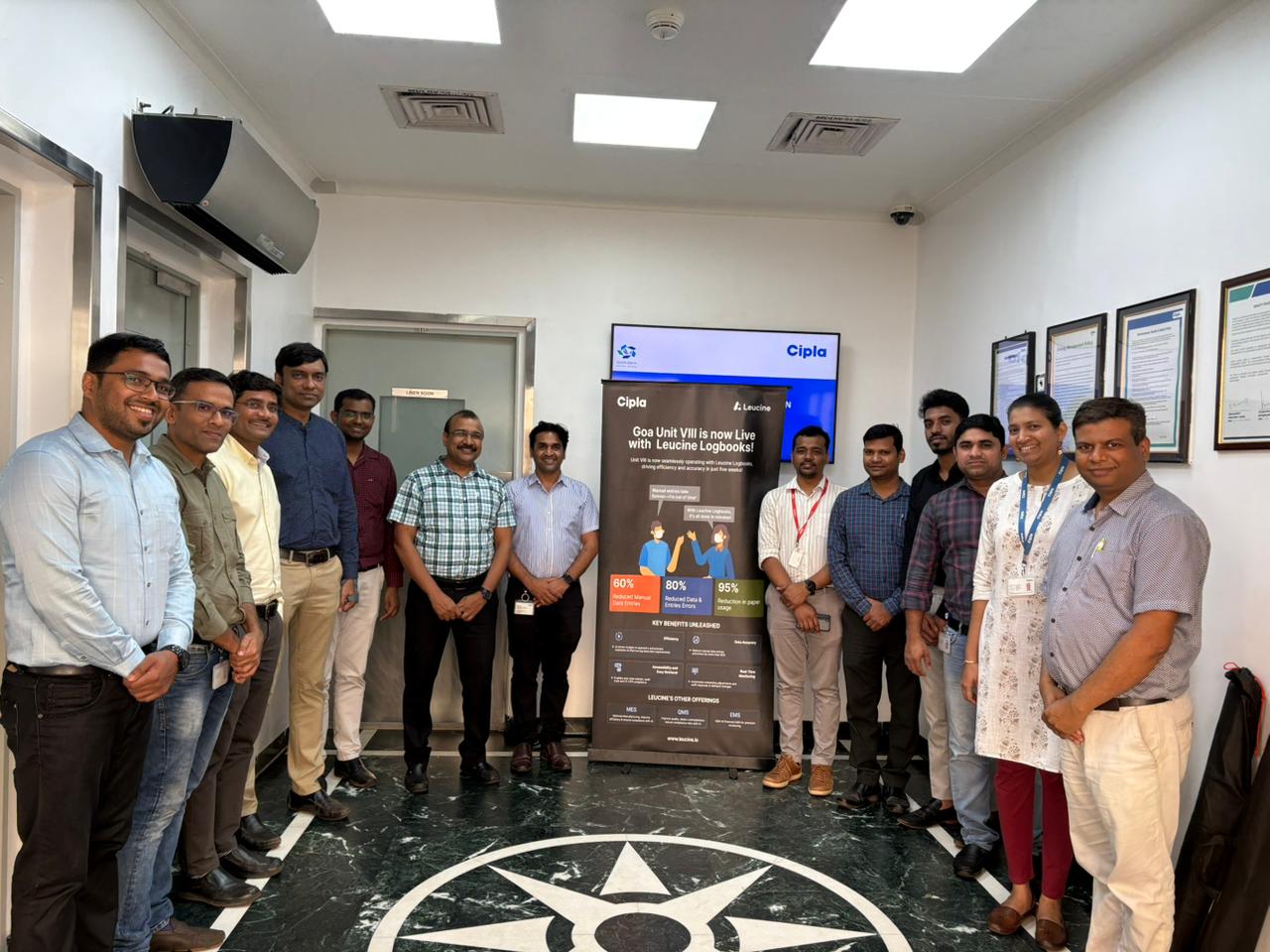
Cipla
"Manual entry is stopped, there is no data integrity issue, and this has made us more compliant."
Instapill
"We were very clear from day one that we have to bring something which is industry first. On data integrity and process quality, Leucine was way ahead amongst the options we evaluated — and we are very happy with that decision."
Frequently Asked Questions
Why should a pharma MES implementation start with electronic batch records?
Electronic batch records address the highest-pain, highest-compliance-risk area first — paper-based batch documentation. Starting with eBMR gives operators a manageable learning curve on familiar workflows, builds digital adoption habits, and delivers fast compliance wins (21 CFR Part 11, ALCOA+ data integrity) before expanding scope. Valent BioSciences went from 20-day to 1-day batch review within weeks of eBMR go-live.
How long does a full pharma MES implementation take with Leucine?
Phase 1 (eBMR) goes live in 8–12 weeks. The full 5-phase journey — from electronic batch records through logbooks, equipment integration, full MES, and AI — typically spans 12–18 months. Each phase builds on the last, so the platform is delivering value from week 8, not month 18. Cipla deployed across 30 facilities, and Piramal across 10+ sites in 3 regulatory jurisdictions.
What is the difference between an eBMR and a full MES?
An eBMR (electronic batch manufacturing record) digitises paper batch records — operators follow guided workflows and the system captures every step. A full MES goes far beyond: it integrates logbooks, equipment data, process interlocks, material traceability, scheduling, and AI-powered intelligence. The eBMR is Phase 1 of MES implementation — the batch record is one output of the complete system.
Why does Cortex AI require 9+ months of data before activation?
AI models need production history to learn what "normal" looks like for your specific products and processes. With 9+ months of batch execution, logbook, and equipment data flowing through the MES, Cortex AI can reliably detect deviations, predict yield, and recommend CAPA actions. Premature AI activation on thin data produces noise, not intelligence.
How does 21 CFR Part 11 compliance work across all five phases?
21 CFR Part 11 compliance is built into the Leucine MES platform itself — not configured per phase. From the first eBMR in Phase 1 through AI-assisted review in Phase 5, every electronic record has electronic signatures with identity verification, immutable audit trails, and role-based access controls. Piramal operates Leucine across FDA, MHRA, and EMA-regulated facilities with 100% Part 11 compliance.
Start with electronic batch records. End with a complete manufacturing execution system. Every phase delivers value, every goal is met, and your operators are with you at every step.