

Cipla + Leucine
30 manufacturing sites. Over 3 million process records. 84 million data entries — building the evidence base for the world's largest paperless manufacturing network.
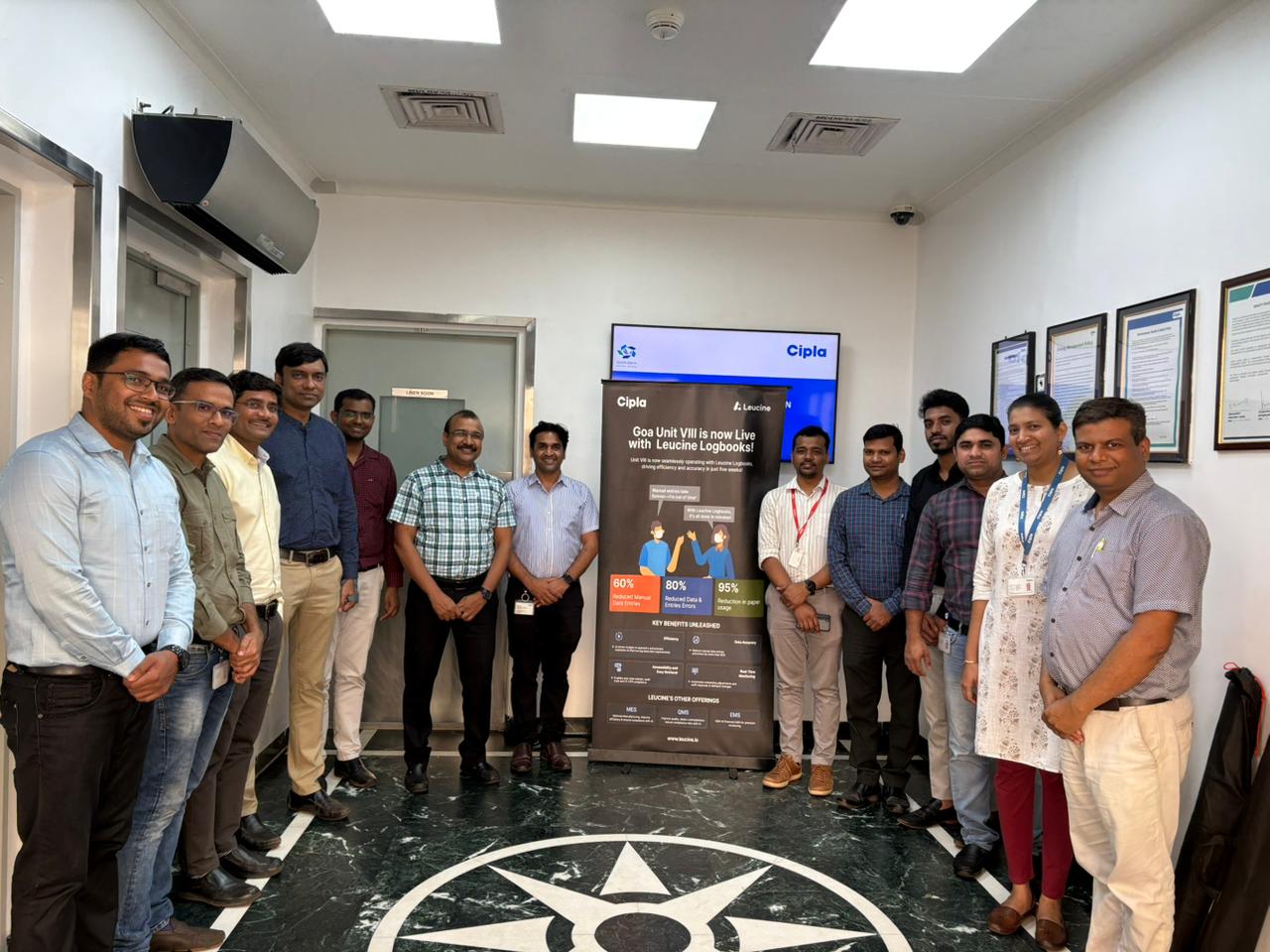
“Manual entry is stopped, there is no data integrity issue, and this has made us more compliant.”
Sanjay Mishra
VP Operations, Cipla
01 /
Challenge
Across Cipla's manufacturing network — spanning Goa, Indore, Kurkumbh, Baddi, Patalganga, and beyond — shop-floor data capture was entirely paper-based. Production logbooks, equipment cleaning records, line clearance checklists, QC testing records, engineering maintenance logs, microbiology monitoring forms — all completed by hand, thousands of entries generated every day, at every facility. Each site had evolved its own templates over years of independent operation. No two facilities captured the same process the same way.
The problem was not volume alone — it was auditability. When a regulator asks to see the evidence trail behind a specific production step at a specific facility on a specific date, the answer on paper is a physical search through binders and archived logbooks. When that question spans 30 facilities simultaneously — which is what a multi-site inspection requires — paper does not provide an answer. It provides a delay, a risk, and an opportunity for gaps to become findings.
That the risk was real became clear in early 2024, when FDA issued observations to one of Cipla's Goa facilities citing inadequate equipment status verification before manufacturing operations — the kind of gap that paper-based logbooks cannot structurally prevent, because paper cannot enforce that a step was completed before the next one begins. The platform that would address it was already being built.
Cipla's leadership understood that the challenge was not simply digitisation — it was scale. Most manufacturing execution systems on the market were built for single-site deployments. A platform capable of running 30 facilities simultaneously, supporting thousands of active users across multiple regulatory jurisdictions, and deploying fast enough to address live regulatory risk — without a per-site licensing model that would make the full network prohibitively expensive — did not exist off the shelf.
- ↪ How do you build a manufacturing record system that is auditable across 30 sites simultaneously — not just a digital filing cabinet?
- ↪ How do you enforce record completeness structurally, when paper cannot prevent blank entries or out-of-sequence steps?
- ↪ How do you deploy at network scale without the per-site cost model that makes enterprise MES unviable for large manufacturers?
- ↪ How do you address live regulatory findings in facilities that are actively under inspection?

02 /
Solution

Leucine's deployment at Cipla began in late 2022 with a deliberate configuration phase. Through most of 2023, the platform was being built — processes mapped, logbook templates designed, workflows configured against Cipla's actual manufacturing procedures at each site. The first major production sites did not go live until early 2024. That preparation mattered: when the platform launched, it launched ready.
Early 2024 was the inflection. Goa and Indore production sites went live simultaneously, and the volume of records in the system went from near-zero to tens of thousands in a single month. Each subsequent month brought more sites, more process categories, and more of the manufacturing workflow moving into the platform. By early 2026, Cipla was generating over 260,000 process records in a single month — a number that would have been inconceivable on paper.
The platform was built around one architectural principle: record completeness must be structural, not dependent on individual discipline. Across nearly 5,000 published process templates, 98.4% of data-capture fields are mandatory — a process record cannot be submitted with blank entries. Every submission carries a system-generated timestamp at the moment it is filed; backdating is structurally impossible. When a correction is made, it is attributed to the individual making it and permanently logged. Over 40,000 corrections are on record across the network — not as evidence of error, but as evidence of a system that captures and attributes everything, including the things people fix.
Indore Unit 1 — Cipla's WEF Global Lighthouse facility — became the reference deployment for what full coverage looks like. Equipment logs, quality control, cleaning documentation, quality assurance, engineering, and microbiology all run simultaneously on the same platform. Every piece of equipment at the facility generates a digital trail. Every operator action is attributable. When an FDA inspector asks for the evidence behind a production decision at this facility, the answer is immediate.
What began as a logbook digitisation programme became operational infrastructure. Quality assurance teams across more than 20 sites brought deviation reports, CAPA documentation, and change control records onto the platform. Engineering teams brought maintenance logs. Microbiology teams brought environmental monitoring records. By April 2026, 15 distinct process categories were running across 30 sites — from E-Log and quality control to microbiology, utility tracking, and IT compliance logs. In parallel, Cipla deployed Leucine CLEEN for cleaning validation — a deployment they considered significant enough to feature in their Annual Report to shareholders.
See the electronic logbooks use case03 /
Impact
3M+
Process records — the cumulative output of three years of live digital manufacturing across 30 sites
84M+
Data entries, each timestamped at point of execution and attributed to a named individual
8,000+
Active credentialed manufacturing staff on the platform — operators, supervisors, QC, QA, and engineering
15
Process categories running simultaneously — from E-Log and QC to microbiology, engineering, and cleaning
Hear from Cipla
In Their Words
“Manual entry is stopped, there is no data integrity issue, and this has made us more compliant.”
Sanjay Mishra
VP Operations, Cipla
Powered by
Leucine MES
The Manufacturing Execution System behind the world's largest paperless manufacturing deployment — over 3 million process records, 84 million data entries, and 15 process categories running simultaneously across 30 sites.
Explore Leucine MES04 /
Schedule a demo
Want to explore how Leucine can help your manufacturing operations achieve similar results? Our team will walk you through the platform and help you find the right solution for your facilities.