Cleaning Validation Protocol: A Step-by-Step Guide
From objective and scope to worst-case selection, residue limits, and the evidence an inspector will ask for.
An investigator stops in front of a multi-product equipment train and asks a single question: what is the current validated cleaning status of this line, and how do you know the last product left no residue behind? In a paper-based programme, the honest answer takes hours — pulling binders, cross-referencing protocols against the current product list, and hoping the worst-case rationale still holds. The question is simple, but the evidence behind it is the entire programme. A cleaning validation protocol is the design for that evidence.
It helps to be precise about what the document actually is. A cleaning validation protocol is not a one-time report filed after three successful runs. It is the design for an ongoing, defensible system that proves residues from one product do not carry into the next above a safe limit. The product mix changes, equipment is added, and procedures are revised — and the protocol has to keep answering the investigator’s question correctly through all of it.
The real test of a protocol is not passing three runs once. It is staying valid the day a new product enters the facility.
What a cleaning validation protocol is
A documented plan, not a finished report.
A cleaning validation protocol is the documented plan that defines how the cleaning of shared or product-contact equipment is validated. It sets out the objective and scope, responsibilities, the worst-case rationale, residue limits, the sampling approach, acceptance criteria, and how results are reported. It exists because cross-contamination control is a direct patient-safety concern and a standing regulatory expectation, not because a binder needs filling.
The expectation is written into the major frameworks. US GMP under 21 CFR 211.67 requires that equipment be cleaned at appropriate intervals under written procedures, with the cleaning documented. EU GMP Annex 15 (Qualification and Validation) sets out cleaning validation as part of the broader validation lifecycle, and the EMA guideline on health-based exposure limits (HBEL) governs how safe carryover limits are derived. PIC/S PI 006 provides detailed recommendations on cleaning validation, and the FDA 1993 Guide to Inspections — Validation of Cleaning Processes remains a foundational reference for what inspectors look for.
One distinction prevents most confusion downstream. The protocol is the plan that defines how validation is performed and judged; the cleaning SOP is the recurring procedure operators follow on the floor every time the equipment is cleaned. The protocol validates the SOP. They are separate documents with separate lifecycles, and conflating them is a frequent source of audit findings.
How to structure the protocol
Four sections carry the weight.
A protocol that holds up under inspection tends to be built from the same load-bearing parts. Each one answers a question an investigator will eventually ask.
Objective and scope
State what is being validated and what is excluded — which equipment train, which products, which cleaning procedure. A scope that is vague invites scope creep and gaps; a scope that is explicit tells the reader exactly what the evidence does and does not cover.
Roles and responsibilities
Name who executes, who samples, who tests, who reviews, and who approves. Cleaning validation crosses production, QC, and QA, and unowned steps are where records fall out of date. Clear responsibility is what keeps the validated state maintained rather than merely achieved once.
Equipment and product grouping
Define the matrix that groups products and equipment so the validation can be bracketed rather than run exhaustively for every combination. The grouping logic is the foundation for worst-case selection and has to be documented, not assumed.
Link to the cleaning SOP
Reference the specific cleaning SOP and version the protocol validates, including parameters such as detergent, temperature, and contact time. If the SOP changes, the protocol has to be re-examined — the link is what makes that dependency visible.
Worst-case product selection
Validate the hardest case to cover the group.
Worst-case product selection is the analytical core of the protocol. Rather than validating every product on every piece of equipment, you identify the combination that is hardest to clean and most hazardous if carried over, then validate that — on the principle that if the worst case passes, the easier cases are covered.
The selection is a risk assessment, not a guess. The standard inputs are solubility (how readily the residue is removed), toxicity expressed through the HBEL or permitted daily exposure, difficulty to clean (the physical tenacity of the residue), and shared surface area across the equipment train. Each candidate product is scored against these factors, and the bracketing logic — which product represents the group, and why — is documented so a reviewer can follow the reasoning.
The obligation does not end when the matrix is signed. Every time a new product is introduced to the facility, the worst-case has to be re-evaluated against it; a newer molecule may be less soluble, more potent, or harder to clean than the existing worst-case, which would invalidate the prior rationale. This recurring re-assessment is precisely where paper-based programmes fail, because there is no automatic trigger to revisit the matrix when the product list changes.
Cleaning procedure and hold times
The procedure and the window it operates in.
The cleaning SOP referenced by the protocol specifies the steps, parameters, and controls that make cleaning reproducible — detergent and concentration, water quality, temperature, flow or scrub action, contact time, and rinse steps. Reproducibility is what allows a small number of validation runs to stand for routine cleaning.
Two time limits bound the operating window. Dirty-hold-time (DHT) is the maximum time equipment may sit soiled before cleaning begins; clean-hold-time (CHT) is the maximum time clean equipment may be held before it is used again. Outside those windows, the validated cleaning result no longer applies, because residue can dry and harden or microbial bioburden can grow.
Both are established experimentally rather than assumed. Equipment is held soiled, or held clean, for the proposed duration and then cleaned or sampled, and the results must meet the same acceptance criteria as a normal run. Because the limits define the edge of the safe window, the validation challenges them at their maximum — proving the procedure still works at the worst point, not just the convenient one.
Sampling and analytical methods
How residue is found and measured.
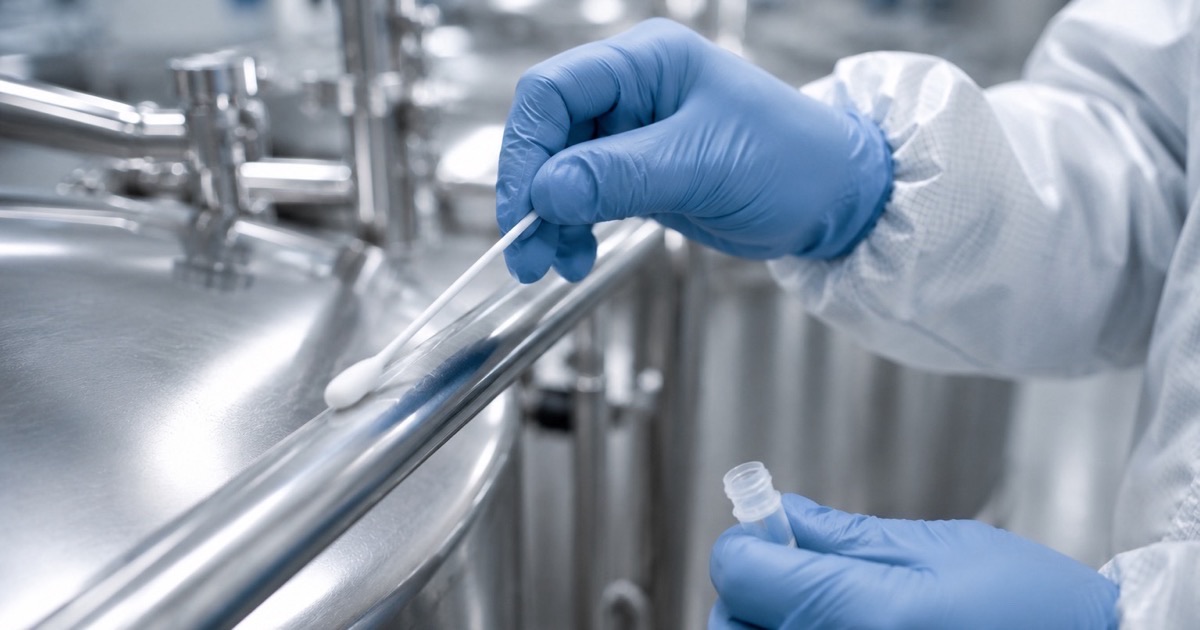
Sampling and analysis convert a clean-looking surface into defensible data. The protocol has to justify where samples are taken, how, and by what method residue is quantified — for the step-by-step method, see the swab and rinse sampling procedure.
Swab sampling
Direct physical sampling of defined, hardest-to-clean locations — corners, joints, dead legs, and other spots where residue is most likely to persist. The sampling-location rationale is documented so the choice of points is defensible rather than convenient.
Rinse sampling
Collecting and analysing the final rinse to assess large or inaccessible surfaces that a swab cannot reach. Rinse sampling complements swabbing by covering total surface area and internal geometry that direct sampling would miss.
Analytical methods
Total organic carbon (TOC) for non-specific detection of any carbon-bearing residue, and HPLC when a specific active has to be quantified. Recovery studies establish how much residue each sampling method actually retrieves, and that recovery factor is applied to the result.
Acceptance criteria and limits
From HBEL to a number on the certificate.
Acceptance criteria turn a safety principle into a measurable threshold. The modern basis is the HBEL or permitted daily exposure, derived from toxicological data, which is then converted into a maximum allowable carryover (MACO) using the next product’s batch size, the shared equipment surface area, and the dosing regimen.
The criteria have evolved. The historical limits — 10 ppm of one product in the next, and 0.1 percent of the therapeutic dose — were once the default, but current EMA and PIC/S expectations favour HBEL-based limits grounded in toxicology. Where more than one criterion applies, the most conservative scientifically justified value is the one that governs, so the limit reflects genuine patient risk rather than a single convenient formula.
A visually-clean requirement sits alongside the numerical limit, not in place of it. The surface must show no visible residue on inspection, and this acts as an additional, immediate check that supports the quantitative result rather than substituting for it.
Execution, deviations and reporting
Running the protocol and closing it out.
Execution puts the design to the test under defined conditions. The protocol typically calls for a number of consecutive successful runs — commonly three — each performed against the worst-case product and the limits of the operating window, including the maximum hold times.
Not every run goes cleanly, and the protocol has to say what happens when one does not. A deviation or a failed result triggers an investigation into root cause and product impact, with corrective and preventive action where the cause is systemic; a failure is data, and suppressing it is the finding an inspector cares about most. The investigation outcome is recorded alongside the run it relates to.
When the runs are complete, a validation report consolidates the results, the deviations and their resolution, and a conclusion on whether the cleaning procedure is validated — and that report is formally reviewed and approved. From that point the work shifts to maintaining the validated state: defined revalidation triggers such as a new worst-case product, a changed cleaning procedure, modified equipment, or periodic review keep the conclusion current rather than letting it quietly expire.
Doing this at scale
Where the paper model breaks down.
The methodology is sound; the difficulty is keeping it current across many products, many pieces of equipment, and several sites at once. A protocol managed in spreadsheets and binders captures a moment in time, while the facility it describes keeps changing underneath it — and the gap between the two is where audit risk accumulates.
Residue-limit calculation
HBEL-to-MACO limits are calculated by hand or in unvalidated spreadsheets, where a single transposed batch size or surface area can carry an error through the whole programme unnoticed.
Limits are computed from toxicological inputs, batch sizes, and shared surface area within a controlled system, applying the most conservative value consistently and removing manual transcription error.
Worst-case matrix maintenance
The matrix is re-examined only when someone remembers to, so a newly introduced product can sit outside the worst-case rationale for months before it is caught.
A new product entering the master list flags the matrix for re-evaluation against current solubility, HBEL, and difficulty-to-clean data, making re-assessment a routine event rather than a missed one.
Protocol generation
Each protocol is assembled by hand from templates, with version drift between the protocol, the SOP it cites, and the limits in force.
Protocols are generated from the current grouping, limits, and procedure, so the document reflects the live state of the programme rather than a copy that has aged.
Cross-site visibility
Each site holds its own binders, and answering a network-wide question on validated status means contacting every site and reconciling formats.
Validated status across every site is visible from one place, so the investigator's question can be answered for any equipment train in minutes rather than days.
The operational case for this is concrete rather than aspirational. One multi-site manufacturer cut cleaning validation cycle times by 80 percent across seven facilities while eliminating manual calculation errors — not by changing the science, but by removing the manual handling that let the programme drift out of date. You can see how a multi-site manufacturer scaled cleaning validation across 7+ facilities for the full account.
The shift is less about software features than about treating the protocol as a living record. A modern cleaning validation software approach keeps limits, matrices, and protocols tied to the current product list, so the answer to the investigator’s question stays correct as the facility changes around it. For the regulatory frameworks that set those limits — from FDA 21 CFR 211.67 to EU GMP Annex 15 — see the cleaning validation guidelines guide.
If you are building or revising a protocol, a structured template is a faster starting point than a blank page. The one below covers scope, worst-case rationale, the sampling plan, acceptance limits, and sign-off.
Download Cleaning Validation Protocol Template
Enter your details once to unlock all Audit Hub resources. All future downloads are instant.
Frequently asked questions
What are the main steps in a cleaning validation protocol?
A cleaning validation protocol typically covers: defining the objective and scope; grouping products and equipment and selecting the worst-case; establishing the cleaning procedure and dirty- and clean-hold times; setting science-based acceptance limits (HBEL/PDE-derived, often alongside the 10 ppm and visually-clean criteria); defining sampling (swab and rinse) and validated analytical methods; executing a defined number of consecutive runs, commonly three; and documenting results, deviations, and final approval. Each step is recorded with full traceability for inspection.
What does 21 CFR require for cleaning validation?
US GMP regulations under 21 CFR 211.67 require that equipment be cleaned, maintained, and sanitised at appropriate intervals using written procedures, with cleaning documented. Cleaning validation demonstrates those procedures are effective and reproducible. Inspectors expect a documented worst-case rationale, scientifically justified residue limits, validated analytical methods, and evidence that the validated state is maintained as products and equipment change.
How are dirty-hold-time and clean-hold-time established?
Dirty-hold-time is the maximum time equipment may sit soiled before cleaning; clean-hold-time is the maximum time clean equipment may be held before use. Both are established experimentally: equipment is held for the proposed duration, then cleaned or sampled for residue and bioburden, and the results must meet acceptance criteria. The validated hold times define the operating window and are challenged at their limits during validation runs.
How are cleaning validation acceptance limits set using HBEL, 10 ppm and MACO?
Modern limits are derived from health-based exposure limits (HBEL or PDE) using toxicological data, then converted to a maximum allowable carryover (MACO) using batch sizes, shared surface area, and dosing. The historical 10 ppm and 0.1 percent of therapeutic dose criteria were once common; current EMA and PIC/S expectations favour HBEL-based limits, applying the most conservative scientifically justified value. A visually-clean criterion is used in addition, not instead.
What is worst-case product selection in cleaning validation?
Worst-case selection identifies the product and equipment combination that is hardest to clean and most hazardous if carried over, so that validating it covers the rest of the group. Selection is risk-based, considering solubility, toxicity or HBEL, difficulty to clean, and shared equipment surface area. When a new product enters the facility, the worst-case must be re-evaluated, which is a common gap in paper-based programmes.
How is cleaning validation handled for dedicated equipment?
Equipment dedicated to a single product does not carry the same cross-contamination risk, so full cross-product validation is not required. Cleaning must still be controlled and documented to manage product build-up, degradation, and microbial bioburden, with verification confirming the procedure remains effective. The dedication rationale itself should be documented and revisited if equipment use changes.
The protocol that survives an inspection is the one that stayed current — through every new product and every changed line.
A cleaning validation protocol is judged less by how it reads on the day it is approved than by whether it still holds when the product mix and equipment have moved on. The science of worst-case selection, residue limits, hold times, and sampling does not change; what changes is the facility around it. Manufacturers who treat cleaning validation as a living, data-driven system — rather than a binder that ages — reduce both their inspection risk and their cycle time, because the evidence behind the investigator’s question is always current.
Related Articles
Swab Sampling Procedure for Cleaning Validation: Methods, Recovery and Limits
How to run swab and rinse sampling for cleaning validation — worst-case locations, the swab technique, recovery studies, the swab limit, and visual checks.
MACO Calculation: Methodology and Formulas for Cleaning Validation
How to calculate MACO three ways — health-based (PDE/ADE), dose-based, and 10 ppm — with formulas, a worked example, and an interactive calculator.

Cleaning Validation Guidelines: A Regulator-by-Regulator Guide
Cleaning validation guidelines mapped regulator by regulator — what FDA, EU GMP Annex 15, EMA, PIC/S, ICH, WHO and APIC require, and where they differ.
Newsletter
Stay ahead in the Industry
Regulatory updates, pharma quality insights, and AI in manufacturing — written for quality leaders, not marketers.
Please use your official work email. Personal email addresses (Gmail, Yahoo, etc.) will not receive the newsletter. No spam. Unsubscribe anytime.
Ready to see what an AI-native quality platform looks like? Leucine unifies quality management, regulatory compliance, and production operations into one intelligent system.