Agentic Batch Review: How AI Agents Reduce Release Cycles from 20 Days to 1
Your batches are finished. Your products are sitting in quarantine. The only thing between manufacturing completion and revenue is a review process designed for the paper era — applied to digital data.
Key Takeaways
Batch review is the single biggest bottleneck between manufacturing completion and revenue. Reviewers manually verify 200-500 data points per batch, spending 70-80% of their time on mechanical data checks rather than quality judgment. The average release cycle is 14-21 days.
85% of flagged batch exceptions are non-critical documentation corrections — wrong timestamps, transcription discrepancies, format mismatches. AI agents can auto-categorise these exceptions, cross-reference MES, LIMS, and EMS data, and surface only the 15% that require human expertise.
Review by exception is not a new concept, but it requires a new architecture. Paper-era review processes applied to digital data produce digital paperwork, not intelligent review. Agentic batch review requires cross-system data integration, automated exception detection, and risk-based triage — built on electronic batch records.
A multi-site deployment demonstrated a reduction from 20 days to 1 day for batch release, with 2,700 hours saved annually and a 60% reduction in manual data entries. The path is Digitise, Automate, Release — and each phase delivers measurable value independently.
A batch completes manufacturing on Friday afternoon. The batch record — 200+ data points spanning weighing, granulation, compression, coating, and packaging — enters the review queue. The assigned reviewer picks it up Monday morning. She opens the electronic batch record and begins the line-by-line verification mandated by 21 CFR 211.192: comparing each recorded parameter against its specification, cross-referencing in-process test results from the LIMS, checking environmental monitoring data from the EMS, and confirming that every operator entry has the required electronic signature.
By Tuesday, she has flagged 12 exceptions. Eight are documentation corrections — a timestamp recorded in the wrong format, a balance calibration entry missing a second signature, a humidity reading transcribed from the monitoring system with a rounding discrepancy. None affect product quality. All require investigation documentation. She routes the exceptions back to production for correction, which takes until Wednesday. She re-reviews Thursday. The batch is released Friday — one full week after manufacturing completed.
This is not a worst case. This is the standard operating reality for batch release in pharmaceutical manufacturing. Multiply it across hundreds of batches per quarter, across multiple products and facilities, and the cumulative impact on throughput, working capital, and time-to-market is staggering. The review process itself is sound — 21 CFR 211.192 exists for critical patient safety reasons. But the method of execution — line-by-line human verification of data that is already captured digitally — is a bottleneck that no amount of reviewer training or overtime can solve.
The batch review requirement under 21 CFR 211.192 is non-negotiable. What is negotiable is whether a human spends 4-8 hours verifying data points that a system already captured electronically — or whether an AI agent pre-screens the record and presents only what requires human judgment.
The Batch Release Bottleneck
Quantifying the cost of review cycles designed for the paper era
The economics of slow batch release are worse than most manufacturing leaders estimate. Every day a batch sits in quarantine is a day of tied-up working capital, delayed revenue recognition, and increased risk of inventory obsolescence. For a mid-size manufacturer processing 300-500 batches per quarter, a 14-21 day review cycle means 30-50 batches are perpetually in the review pipeline at any given time.
The direct labour cost is significant — 4-8 hours of reviewer time per batch at senior quality analyst rates — but the indirect cost is far larger: delayed market supply, emergency shipment costs when release timelines slip, and the compounding effect of slow release on an industry already facing $50-65 billion in annual yield losses.
200-500
Data points per batch
Each requiring verification against specifications, cross-system references, and regulatory requirements under 21 CFR 211.192
70-80%
Reviewer time on mechanical checks
Spent confirming data already captured digitally — timestamps, signatures, transcriptions — rather than exercising quality judgment
14-21 days
Average release cycle
From manufacturing completion to batch disposition, driven by sequential review, exception routing, and re-verification loops
Why Manual Review Persists
Four structural problems that electronic batch records alone do not solve
The industry digitised the batch record. It did not digitise the review. Most electronic batch record deployments replaced paper forms with electronic forms — the data entry moved to a screen, but the review process remained fundamentally unchanged. A reviewer still opens the record and walks through it line by line, checking each entry against its specification.
This is not a technology failure. It is an architecture failure. Four structural problems explain why manual review persists even in facilities with mature electronic batch record systems.
Line-by-line review is the regulatory default
21 CFR 211.192 requires that batch production and control records be reviewed before batch disposition. In practice, most quality units interpret this as requiring human verification of every data point — because the regulations were written when batch records were paper documents with no automated checks. The review process was designed for a world where every number was hand-written and every transcription was a potential error.
Sequential data gathering across disconnected systems
A complete batch review requires data from the MES (process parameters, operator entries), LIMS (in-process and release testing), EMS (environmental monitoring), equipment logs (calibration, maintenance), and document management (SOPs, master batch records). Even in digitised facilities, the reviewer manually navigates between these systems, assembling the complete picture one screen at a time.
Exception overload drowns signal in noise
When every deviation from the expected value is flagged equally — whether it is a critical process parameter excursion or a timestamp formatting discrepancy — the reviewer cannot prioritise. Industry data shows that 85% of batch exceptions are non-critical documentation corrections. But without automated triage, the reviewer investigates each one sequentially, spending the same cognitive effort on a rounding discrepancy as on a genuine quality concern.
No cross-batch context or pattern recognition
Each batch is reviewed in isolation. The reviewer who flags a compression force that drifted 2% above the setpoint has no systematic way to check whether the same drift occurred in the previous five batches of the same product — which would indicate a calibration issue rather than a single-batch anomaly. Cross-batch reasoning requires querying historical data that most review processes do not surface.

The problem is not that reviewers are slow. The problem is that the review process asks humans to do what systems should do — verify data against specifications — while delaying what only humans can do: exercise quality judgment on genuine exceptions.
Review by Exception, Powered by Agents
How AI agents transform the batch review paradigm
Review by exception is not a new concept. ICH Q8, Q9, and Q10 established the framework for risk-based approaches to pharmaceutical quality — including the principle that review effort should be proportional to risk. What has been missing is the technology architecture to implement it at scale: systems that can pre-screen batch records, automatically categorise exceptions by severity, cross-reference data across systems, and present the reviewer with only what requires human judgment.
AI agents provide this architecture. Unlike static rules engines that flag deviations from hard-coded limits, agents reason across the full batch context — comparing current values against historical distributions, correlating anomalies across systems, and distinguishing between documentation artefacts and genuine quality signals.
Evolution of batch review: from paper to AI-assisted eBR
| Dimension | Paper Review | eBR Alone | AI-Assisted eBR |
|---|---|---|---|
| Review scope | Every line, every page | Every field, every screen | Exceptions only — 15% of data points requiring human judgment |
| Data assembly | Reviewer collects paper from 3-5 departments | Reviewer navigates between 3-5 electronic systems | Agent aggregates data from all systems in parallel, pre-assembled |
| Exception detection | Reviewer compares each value to specification manually | System flags values outside hard-coded limits | Agent detects statistical anomalies, cross-system inconsistencies, and pattern-based risks |
| Exception triage | All exceptions treated equally — sequential investigation | Colour-coded severity based on deviation magnitude | Agent auto-categorises 85% as non-critical with documented rationale; escalates 15% for human review |
| Cross-batch context | None — each batch reviewed in isolation | Limited — reviewer can manually query history | Agent automatically surfaces trending parameters and recurring exception patterns across batches |
| Review cycle | 14-21 days | 10-14 days | Same-day release for batches with no critical exceptions |
| Reviewer role | Data verification + quality judgment | Data verification + quality judgment | Quality judgment on pre-screened exceptions |
Parameter verification
Reviewer checks each of 200+ parameters against its specification: granulation endpoint torque, blend time, compression force, tablet weight, hardness, friability, dissolution, coating weight gain. Each check requires opening the relevant section, comparing the value, and documenting the verification.
4-8 hours per batch
Agent scans all parameters in parallel, compares against specifications and historical distributions. Flags only statistically significant deviations — a compression force 0.3% above setpoint but within the normal distribution for this product is classified as non-critical. A compression force trending upward across three consecutive batches is flagged for human review.
Minutes
Exception triage
Reviewer documents each exception identically: description, root cause, impact assessment, corrective action. A missing second signature on a balance calibration check receives the same investigation workflow as a process parameter excursion. The queue grows; the reviewer context-switches between critical and administrative exceptions.
1-3 days per batch for exception resolution
Agent categorises exceptions by type and risk: documentation corrections (auto-resolved with audit trail), process parameter deviations within historical range (flagged as informational), and genuine quality signals requiring human assessment (escalated with full context from MES, LIMS, and EMS pre-assembled).
Seconds for triage; human review of escalated items only
Cross-system correlation
Reviewer notices a dissolution result slightly below trend. To investigate, she manually logs into the LIMS for analytical data, the EMS for humidity during coating, and the MES for coating spray rate. Each system requires separate authentication. By the time the data is assembled, the correlation — if it exists — depends on the reviewer's memory and experience.
Hours of manual assembly
Agent automatically correlates the dissolution result with coating parameters from the MES, humidity data from the EMS during the coating window, and dissolution trends across the last 20 batches. Presents the reviewer with a pre-assembled evidence package: 'Dissolution at 97.2% vs. 98.5% average. Coating humidity was 62% RH vs. 55% RH normal. Similar pattern observed in Batch 2841 and Batch 2803.'
Pre-assembled before reviewer opens the record
Deployment Evidence
Measured results from multi-site implementations
The architecture described above is not theoretical. Organisations that have deployed electronic batch records with cross-system integration, automated data capture, and exception-based review workflows are measuring the impact. The results below are from a multi-site deployment across a global manufacturer processing 1,800+ batches through a digital platform.
The right-first-time rate — the percentage of batches that pass review without requiring correction or rework — is a leading indicator of review efficiency. Industry benchmarks show 90-95% for oral solid dosage and 85-92% for sterile products. Digitised batch records with automated data capture push right-first-time rates toward the upper bound by eliminating transcription errors at the point of entry.
20→1 days
Batch review cycle
Reduced from 20 days to same-day release through automated cross-system data aggregation and exception-based review
2,700 hrs/year
Manual effort eliminated
Previously spent on line-by-line data verification, cross-system data gathering, and non-critical exception documentation
60%
Reduction in manual data entries
Automated capture from process equipment eliminates the transcription errors that generate the majority of non-critical exceptions
The 20-to-1-day reduction was not achieved through a single technology change. It was the result of a three-phase approach: first digitising the batch record and automating data capture (eliminating transcription errors), then deploying automated exception detection and cross-system correlation (eliminating manual data assembly), and finally implementing exception-only human review (eliminating line-by-line verification of compliant data points). Each phase delivered incremental improvement; together they transformed the release cycle.
The 2,700 hours saved annually at a single facility were redistributed to higher-value quality activities: trend analysis, process improvement investigations, and proactive risk assessment. The batch reviewer’s role shifted from data verifier to quality decision-maker — the role that 21 CFR 211.192 was designed to protect.
Implementation Framework: Digitise, Automate, Release
A three-phase roadmap for agentic batch review
Agentic batch review cannot be deployed into a paper-based environment. The prerequisite is a digital batch record with automated data capture — without this foundation, the agent has nothing to reason over. The roadmap below reflects the sequence that works in practice, with each phase delivering standalone value while building the foundation for the next.
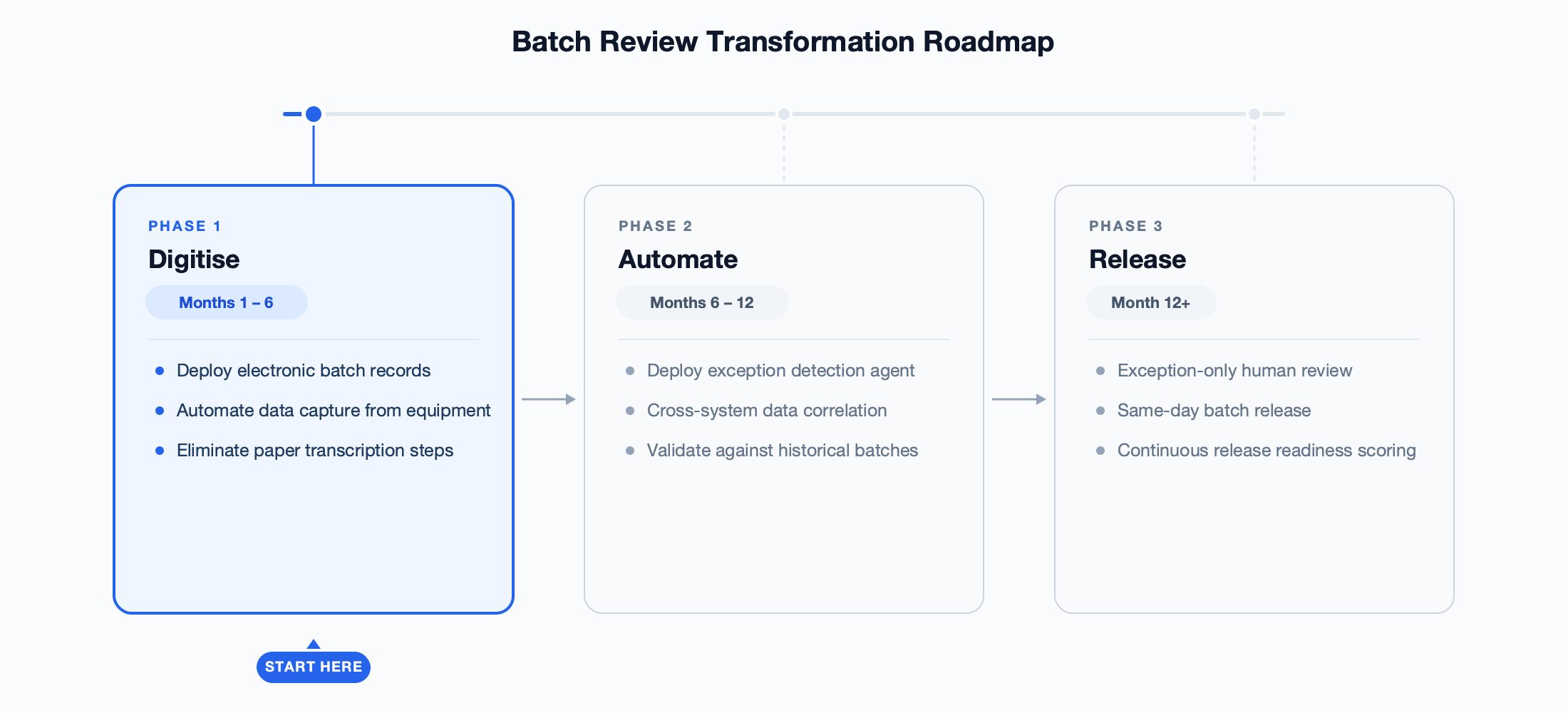
Phase 1: Digitise
Deploy electronic batch records with automated data capture from process equipment, balances, and environmental monitoring systems. Eliminate paper transcription and the transcription errors that generate 60-70% of non-critical exceptions. Establish the digital data foundation the agent needs. This phase alone typically reduces review cycles by 30-40% by eliminating the most common exception categories.
Phase 2: Automate
Deploy exception detection agents that cross-reference MES, LIMS, and EMS data in parallel. Auto-categorise exceptions as critical (requires human review), informational (within historical range), or administrative (documentation correction). Validate agent categorisation against historical reviewer decisions across 200+ batches before transitioning to production use.
Phase 3: Release
Transition to exception-only human review with continuous release readiness scoring. The agent pre-screens every batch and presents the reviewer with a disposition-ready summary: compliant parameters confirmed, exceptions categorised and triaged, cross-batch trends surfaced. The reviewer exercises quality judgment on the 15% that matters — and the batch releases the same day manufacturing completes.
The competitive advantage of same-day batch release is not just operational — it is financial. Every day removed from the release cycle is a day of working capital freed, a day of earlier revenue recognition, and a day of reduced inventory risk. For a manufacturer processing 1,000+ batches per year, the difference between 20-day and same-day release is measured in millions.
21 CFR 211.192 requires that batch production and control records be reviewed and that any unexplained discrepancy be investigated. This requirement is not changing — nor should it. What agentic batch review changes is the mechanism of compliance: instead of a human verifying every data point to confirm what a digital system already captured correctly, the system pre-screens the record, categorises exceptions by risk, and presents the reviewer with the judgment calls that only a human quality professional can make.
The ICH Q8/Q9/Q10 framework explicitly supports risk-based approaches to quality operations. The organisations that apply this framework to batch review — digitising the record, automating the verification, and focusing human expertise on genuine quality decisions — will release faster, with higher confidence, and with audit trails that demonstrate not just what was reviewed but how the review was prioritised. The 20-day release cycle is not a regulatory requirement. It is an architectural choice. And it is one that the industry can no longer afford.
Related Articles

The Quality Ontology: Why Pharma AI Needs a Knowledge Graph, Not a Data Warehouse
A technical deep-dive into the quality ontology — the connected knowledge model that enables AI agents to reason across MES, LIMS, QMS, and ERP simultaneously. How the Ontology Builder Agent constructs it, how the signal layer keeps it alive, and why this architecture is the prerequisite for every agentic use case in pharmaceutical manufacturing.

Predictive Product Quality: Why Agentic Architecture Outperforms ML Models and Dashboards
Product quality prediction requires a network of specialised AI agents — not a single ML model. How agents, skills, sub-agents, and standardised tool interfaces deliver continuous risk intelligence that annual CPV reviews structurally cannot.

Agentic AI vs. AI Copilots in Pharma: Why Architecture Determines Impact
Most pharma AI deployments are copilots — reactive, single-step, human-prompted. Agentic AI is architecturally different: goal-directed, multi-step, and autonomous within guardrails. A technical framework for CIOs.
Newsletter
Stay ahead in the Industry
Regulatory updates, pharma quality insights, and AI in manufacturing — written for quality leaders, not marketers.
Please use your official work email. Personal email addresses (Gmail, Yahoo, etc.) will not receive the newsletter. No spam. Unsubscribe anytime.
Ready to see what an AI-native quality platform looks like? Leucine unifies quality management, regulatory compliance, and production operations into one intelligent system.