Key Takeaways
Most pharmaceutical AI deployments are document chatbots — retrieval-augmented generation (RAG) over SOPs and regulatory guidance. These systems can search unstructured knowledge but cannot access the structured operational data in MES, LIMS, or EMS where quality decisions actually live.
The missing architectural layer is standardised tool access. Model Context Protocol (MCP) — an open standard for connecting AI agents to external systems — acts as 'USB-C for AI,' replacing the proprietary point-to-point integrations that keep pharma AI stuck at demo stage.
A deployable pharma AI agent requires three layers working in concert: a knowledge base (RAG) for regulatory and procedural context, a tool access layer (MCP) for real-time queries to operational systems, and a reasoning engine that can plan multi-step workflows across both — with every tool call audit-trailed under 21 CFR Part 11.
The FDA itself deployed agentic AI across 70%+ of its staff in December 2025. Annex 22 enforcement is expected by 2027. The architecture decisions IT leaders make in the next 12 months will determine whether their organisations can deploy compliant, production-grade AI agents — or remain stuck with chatbots.
A quality team at a multi-site manufacturer spends four hours investigating a deviation. The batch record is in MES. The analytical results are in LIMS. The environmental monitoring data is in EMS. The relevant SOP is in the document management system. The historical deviation pattern is buried across three years of QMS records. The investigator has five browser tabs open, manually cross-referencing data that exists in five separate systems with no shared context.
This is the integration problem that keeps pharmaceutical AI at chatbot level. The industry has spent two years deploying RAG — retrieval-augmented generation — over document repositories. These systems can search SOPs, summarise regulatory guidance, and answer questions about procedures. They are useful. They are also fundamentally incomplete. A document chatbot has no idea what is happening on the shop floor right now. It cannot query a live batch record, check an in-process analytical result, or verify that environmental conditions were within specification during a critical step. It reads about your operations. It cannot observe them.
This whitepaper defines the three-layer architecture that separates a deployable pharma AI agent from a document chatbot: knowledge bases for regulatory and procedural context, standardised tool interfaces for real-time system access, and a reasoning engine that orchestrates both within GMP-compliant guardrails. For CIOs and VP IT leaders evaluating their AI infrastructure strategy, this architecture is the prerequisite for every agentic use case the industry is promising.
The question is not whether your AI can search your SOPs. It is whether your AI can simultaneously query five operational systems, reason across both unstructured knowledge and structured data, and produce an auditable conclusion — without a human manually bridging the gaps.
The 6% Problem
Why massive AI potential remains locked behind an architecture gap
The adoption numbers in pharmaceutical manufacturing expose a structural contradiction. Only 6% of manufacturers use AI in production (Deloitte, 2025), yet an Accenture-Wharton study estimates 55% of biopharma workforce hours are impactable by AI agents — representing $180-240 billion in annual US value. Gartner projects that by 2028, 33% of enterprise software will include agentic AI capabilities. The potential is quantified. The adoption is negligible.
The gap is not talent, budget, or executive sponsorship. It is architecture. Most pharma facilities operate 9-12 separate systems — MES, LIMS, QMS, EMS, DMS, CMMS, ERP, process historians, and more — each with its own data model, API (if any), and access controls. Quality teams spend 60-70% of their time on documentation rather than improvement, not because they lack AI, but because no system can reason across all the data their work requires. The $50-65 billion in annual yield losses linked to data silos is a symptom. The disease is an integration architecture built for humans to manually bridge, not for AI agents to autonomously traverse.
6%
Of manufacturers using AI in production
Despite widespread pilot activity, production deployment remains exceptionally rare (Deloitte, 2025)
55%
Of biopharma hours impactable by agents
Accenture-Wharton estimates the majority of pharmaceutical work is structurally ready for AI agents
$180-240B
Annual US value from agentic AI
Projected biopharma value from autonomous AI agents in the United States alone (Accenture, 2025)
Why Document Chatbots Hit a Ceiling
Four architectural limitations that prevent RAG-only systems from becoming agents
The pharma industry’s first wave of AI deployment followed a predictable pattern: embed SOPs and regulatory documents into a vector database, add a retrieval layer, connect a language model, and call it an AI assistant. This is RAG — and for document search, it works. The problem is that document search is not where the operational value lies. The value lies in cross-system reasoning, and RAG alone cannot get there.
RAG only accesses unstructured knowledge
A document chatbot can search SOPs, deviation reports, and regulatory guidance — all unstructured text. It cannot query the MES for current batch status, pull an analytical result from LIMS, or check environmental conditions from the building management system. These are structured, real-time data sources that require API access, not document retrieval. When an investigation requires both the SOP and the batch record, RAG delivers half the picture.
No system produces answers in isolation
A deviation investigation requires correlating the batch record (MES) with analytical results (LIMS), environmental data (EMS), equipment maintenance history (CMMS), and the applicable SOP (DMS). A document chatbot can search one repository. An agent needs to query all five, reason across the results, and synthesise a conclusion. The 9-12 systems in a typical pharma facility are not a complexity problem — they are a connectivity problem.
Document retrieval is not action
RAG retrieves text chunks and generates a response. It cannot write an entry to the batch record, update a deviation classification, trigger a CAPA workflow, or log a verified calculation. In GMP manufacturing, value is created when data moves between systems and decisions are recorded with audit trails — not when text is summarised.
Every integration is bespoke and fragile
Organisations that have attempted to connect AI to operational systems have built custom point-to-point integrations — one connector per system, per use case. Each connector requires separate validation, separate maintenance, and separate security review. The result is an integration architecture that does not scale. Adding a new system or a new use case means building another custom connector from scratch.
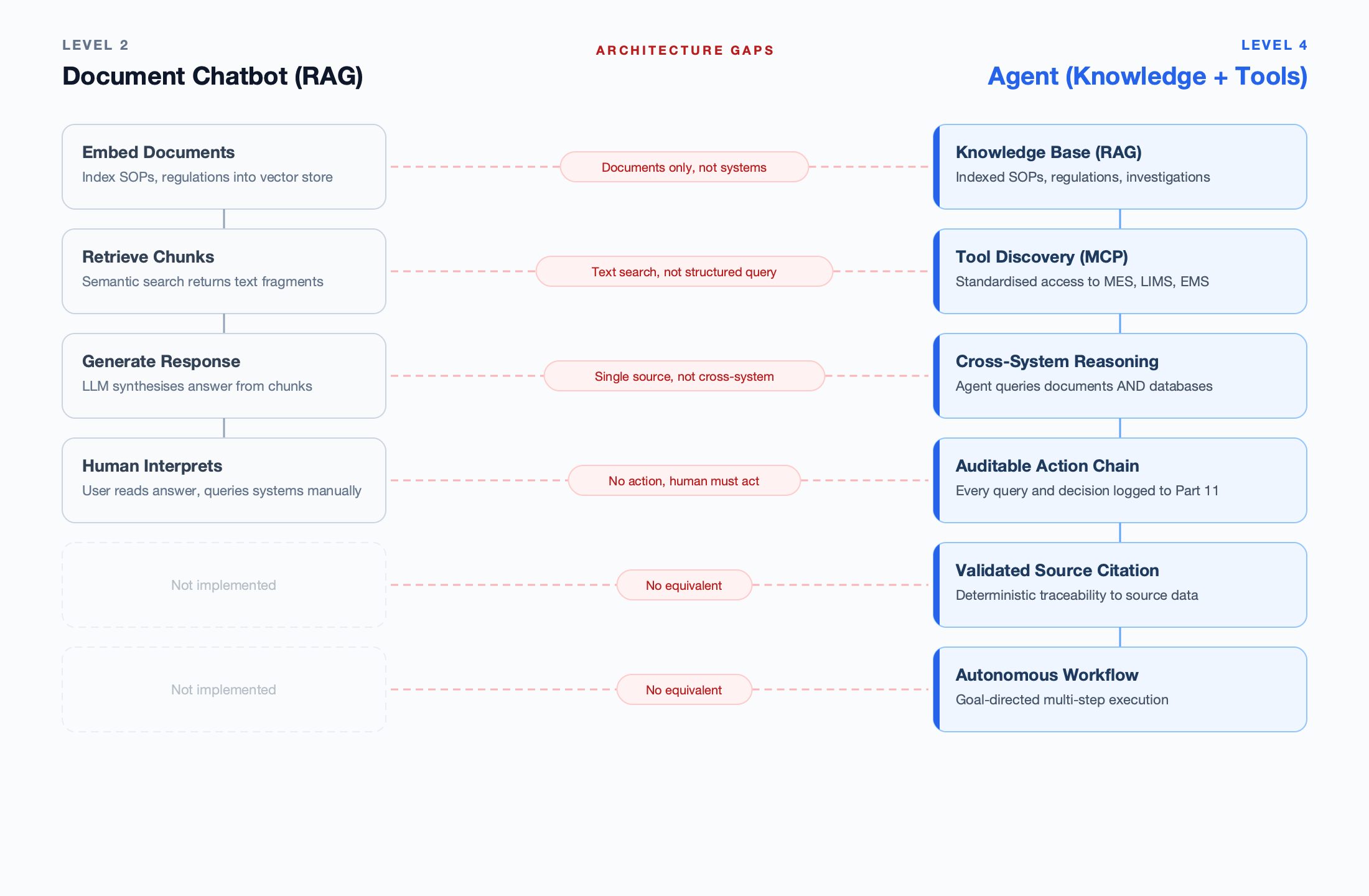
A document chatbot reads about your operations. An agent with tool access observes your operations in real time. The difference is not intelligence — it is architecture. The same language model, connected to the right systems through standardised interfaces, becomes a fundamentally different capability.
The Three-Layer Architecture
Knowledge base + tool access + reasoning engine: the stack that makes agents deployable
A deployable pharma AI agent requires three architectural layers, each solving a distinct problem. The knowledge base layer (RAG) provides regulatory and procedural context — the “why” behind quality decisions. The tool access layer provides real-time connectivity to operational systems — the “what is happening now.” The reasoning engine orchestrates both, planning multi-step workflows and maintaining an audit trail that satisfies 21 CFR Part 11.
The critical innovation in this architecture is the tool access layer. Model Context Protocol (MCP), an open standard published by Anthropic in late 2024 and now adopted across the AI industry, provides a standardised interface for AI agents to discover and use external tools. Think of MCP as USB-C for AI: instead of building a proprietary cable for every device, you build one standardised port. An MCP server wraps each operational system — MES, LIMS, EMS, QMS — in a consistent interface that any MCP-compatible agent can discover, authenticate against, and query. One protocol, every system.
Document chatbot vs. AI copilot vs. three-layer agent architecture
| Dimension | Document Chatbot (RAG) | AI Copilot | Agent Architecture (Knowledge + Tools) |
|---|---|---|---|
| Data access | Unstructured documents only (SOPs, guidance) | Documents + single-system context | Documents + real-time access to MES, LIMS, EMS, QMS, CMMS via MCP |
| Action capability | Generate text responses | Draft reports, suggest classifications | Query systems, correlate data, log entries, trigger workflows |
| Reasoning | Single retrieval-generation cycle | Contextual suggestions within one screen | Multi-step planning: decompose goal, query systems, synthesise, validate |
| Audit trail | Conversation log | Application-level interaction log | Every tool call, data retrieval, reasoning step, and decision logged with timestamps and rationale |
| Part 11 compliance | Not applicable (no GMP records created) | Inherits from host application | Native: tool calls are signed, attributable, and tamper-evident |
| Integration model | Embed documents into vector store | API to one host system | MCP servers per system — standardised, discoverable, independently validated |
| Scalability | Add more documents | Build new copilot per application | Add MCP server for new system — agent discovers it automatically |
Why MCP changes the economics of pharma AI integration
The traditional approach to connecting AI with operational systems is point-to-point: build a custom API connector from the AI application to MES, another to LIMS, another to EMS. Each connector must be developed, tested, validated (per GAMP 5 guidelines), documented, and maintained. For a facility with 9-12 systems and five AI use cases, that is 45-60 custom integrations — each a potential compliance liability and maintenance burden.
MCP inverts this equation. Each system gets one MCP server — a standardised wrapper that exposes the system’s capabilities (read batch record, query analytical result, check environmental data) as discoverable tools. Any MCP-compatible agent can then find and use these tools without custom integration code. Adding a new AI use case requires zero new connectors. Adding a new system requires one MCP server, not one connector per use case.
For IT leaders, the implication is architectural: validate the MCP server once per system, and every agent that uses it inherits that validation. The compliance surface area shrinks from O(systems x use cases) to O(systems). This is the scaling model that makes pharma AI agents economically viable beyond a single proof-of-concept.
Part 11 audit trails for agent tool calls
Every MCP tool call generates a structured audit record: which agent requested the action, which system was queried, what parameters were sent, what data was returned, and when. This is ALCOA+ applied to AI-system interactions — attributable, legible, contemporaneous, original, and accurate. The reasoning engine logs its planning steps and decision rationale alongside these tool call records, creating a complete chain of evidence from goal to conclusion.
For 21 CFR Part 11 compliance, this means every AI agent action is as auditable as a human operator’s electronic signature. The audit trail does not require post-hoc reconstruction. It is generated as a byproduct of the architecture itself.
Deployment Evidence
What cross-system AI architectures deliver when the integration layer is in place
The three-layer architecture is not speculative. Organisations that built their digital platforms with cross-system integration, standardised data access, and audit trail infrastructure from the start are demonstrating what becomes possible when AI agents can traverse operational systems rather than merely search documents.
These results come from multi-site pharmaceutical deployments operating under FDA, MHRA, and EMA oversight — environments where every data access and every decision must be defensible under inspection.
20→1 days
Batch review cycle
Automated cross-system data aggregation replaced manual retrieval from MES, LIMS, and EMS — collapsing review from 20 days to 1
2,700 hrs/year
Manual effort eliminated
Previously spent on cross-referencing data between disconnected systems — time now redirected to process improvement
60%
Reduction in manual data entries
Standardised system integration eliminated transcription between systems, reducing both effort and transcription error
Implementation Roadmap: Connect, Validate, Scale
A phased approach for IT leaders building the agent architecture stack
Deploying the three-layer architecture is not a single project. It is a progression that mirrors how regulated industries adopt any infrastructure-level technology: establish connectivity, validate compliance, then scale across workflows and sites. Organisations that attempt to skip phases — deploying agents before MCP servers are validated, or scaling before audit trail architecture is proven — will encounter the same compliance failures that plagued early cloud migrations in pharma.
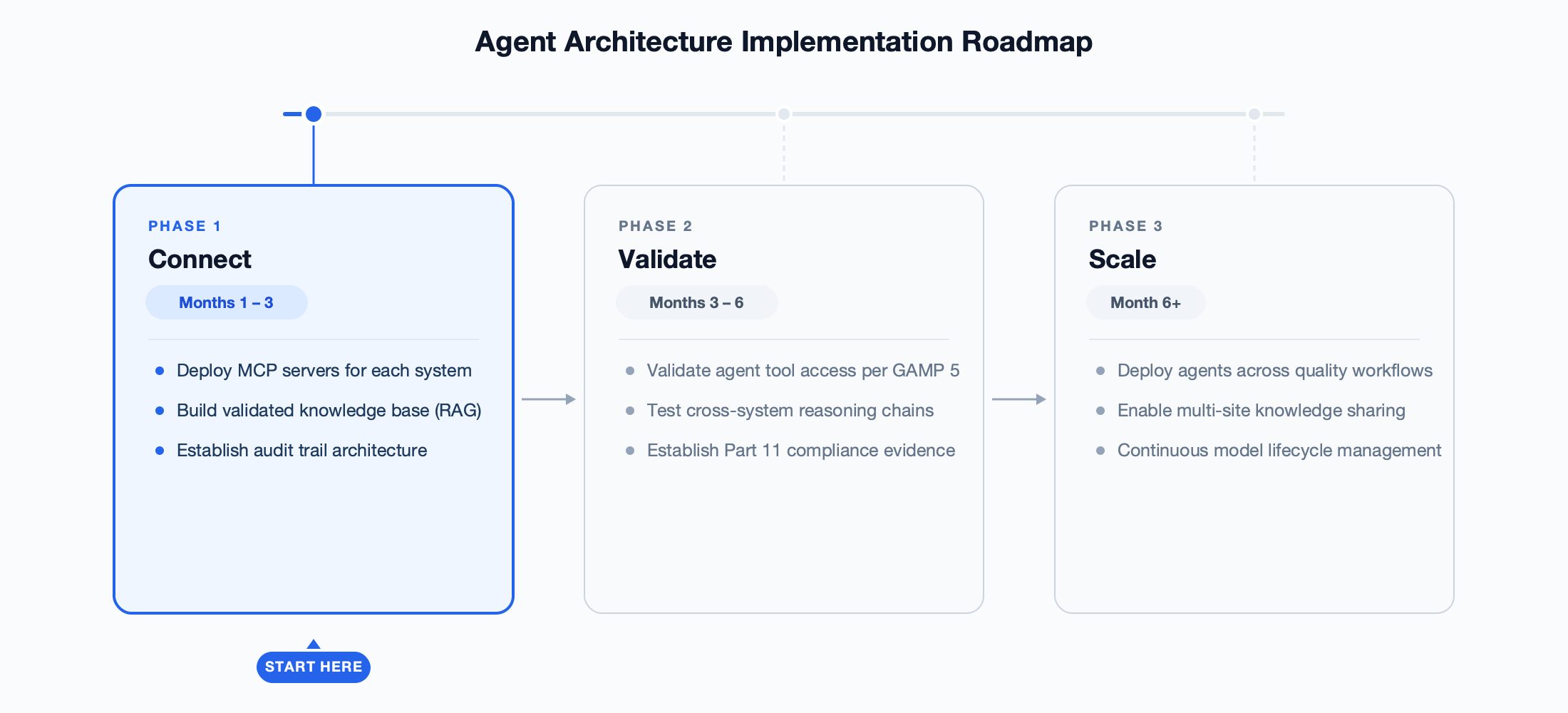
Phase 1: Connect
Deploy MCP servers for each operational system — MES, LIMS, EMS, QMS, CMMS. Build the validated knowledge base from SOPs, regulatory guidance, and historical investigation data. Establish the audit trail architecture that will capture every agent-system interaction. This phase is infrastructure, not AI: it creates the connectivity layer that agents will use.
Phase 2: Validate
Validate each MCP server's tool access per GAMP 5 Category 4/5 guidelines. Test cross-system reasoning chains against known outcomes — use historical deviation investigations where the answer is known to verify agent accuracy. Establish Part 11 compliance evidence: demonstrate that every tool call, data retrieval, and reasoning step is captured in a tamper-evident, attributable audit trail.
Phase 3: Scale
Deploy agents across quality workflows — deviation investigation, batch review, CAPA effectiveness monitoring, cleaning validation lifecycle. Enable multi-site knowledge sharing: agents at one facility learn from investigations at another. Implement continuous model lifecycle management aligned with Annex 22 requirements for drift monitoring and re-validation triggers.
The organisations that will deploy production-grade pharma AI agents are not the ones with the most sophisticated models. They are the ones that built the integration architecture first — standardised tool access, validated knowledge bases, and audit trails that satisfy Part 11 before the first agent was turned on.
The FDA deployed agentic AI across 70% of its staff in December 2025 — a tool called Elsa, built on Anthropic’s Claude, used for pre-market reviews, inspection support, and regulatory analysis. The regulator is adopting the same class of technology it is preparing to regulate under Annex 22. This is not a future scenario. It is the current operating environment.
For CIOs and VP IT leaders, the strategic question has shifted. It is no longer “should we deploy AI?” — every pharmaceutical company will answer yes within 18 months. The question is whether your integration architecture can support agents that reason across operational systems with full audit trails, or whether your AI remains confined to searching documents. The three-layer architecture — knowledge bases for context, MCP for standardised tool access, and a reasoning engine for cross-system orchestration — is the infrastructure prerequisite for every agentic use case the industry is pursuing. The organisations that build this stack now will not merely be more efficient. They will operate in a structurally different way, setting the compliance and operational standard that the rest of the industry will spend years trying to replicate.